

Setting up millions of e-commerce stores around the globe, Magento is a perfect platform with a rich ecosystem, enterprise-ready capabilities, and an open-source nature. It’s ideal for brands looking to offer exceptional user experience, optimized business operations, and scalability. No matter whether you want to start a new online brand, enhance a website, or migrate from your existing e-commerce platform, custom Magento development services ensure everything. They optimize performance, curate personalized shopping experiences, and integrate seamlessly with different third-party tools such as payment gateways, ERP systems, and CRMs.
Magento Web Development Services
Here are the top custom Magento development solutions for your e-stores:
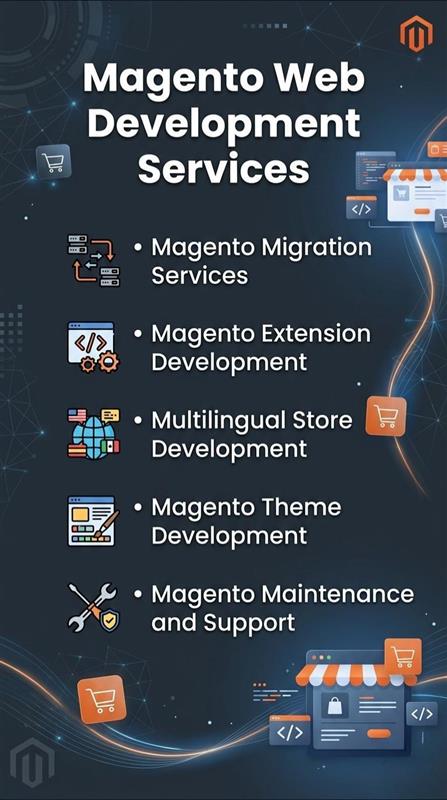
Magento Migration Services
Migrate your eCommerce business from another platform to Magento and take advantage of the numerous features offered by this open-source framework. Our highly qualified personnel execute the conversion procedure flawlessly, without data loss and minimal delay.
Magento Extension Development
Convert your Magento-based eCommerce store into a robust and scalable platform and compete with the greatest eCommerce platforms on the market. Create a customized extension that enhances your business’s functionality and provides a superior buying experience to your customers.
Multilingual Store Development
Engage Magento developers to help you expand your eCommerce business’s capabilities and reach. Our developers provide cross-platform and multilingual solutions that enable you to reach customers from diverse cultural and geographic backgrounds.
Magento Theme Development
Employ Magento developers and leverage our theme development services to create powerful, responsive, scalable, and superior themes. Our coders create pixel-perfect themes that enhance the aesthetics of your platform and increase client engagement, resulting in increased conversions and profitability.
Magento Maintenance and Support
Hire Magento developers to ensure high-quality, uninterrupted, 24/7 technical support and customer service. When you collaborate with us, we take care of all site difficulties, bugs, and downtime, ensuring that your eCommerce platform operates properly.
Factors to Consider While Picking a Magento Development Company?
Finding a trustworthy developer is not a simple task. However, if you are sure what to look for, you can make the right choice. The following are a few critical aspects and tips to hire certified Magento 2 development experts or to consider while selecting a Magento development company.

Experience
It is most likely the most critical thing to consider when selecting a Magento development firm. You should seek out an experienced Magento developer who has worked with various e-commerce enterprises and demonstrated their expertise with perfect outcomes.
Security
Probably the most critical factor of all is security. Because your web will manage critical functions such as billing, client information, and so on, you should seek out a developer who has never encountered a security breach in the past to ensure your website remains secure by following PCI DSS 4.0 Magento security best practices. Now, on the Magento market, Security extensions have been released to ensure that critical data on your site is always secure and protect you from prospective hackers.
Support
Before making a choice, you must know the type of support you will receive from the Magento development business during the website creation process. A reputable development company will oversee the entire process from start to finish, adhere to a strict deadline, and keep you informed at every stage.
Consider what your firm requires to be successful and seek a developer who can meet those requirements. Apart from development, various organizations provide ancillary services such as marketing, SEO, security features, and design. As a result, you should choose the most appropriate supplier based on your requirements.
Portfolios
Any reliable Magento development company has positive client reviews and a strong portfolio displaying their successful projects across multiple industries. They must have Magento certifications and recognition in the Magento community.
Customization Abilities
Magento experts for e-commerce offer customized extensions for workflow automation, ensure unique checkout experiences to minimize cart abandonment, and personalized themes for engagement and branding.
Why should one go for Magento 2?

Open-Source Platform
Companies don’t have to spend much money upfront because Magento is an open-source platform. The unique nature of Magento allows them to cooperate with developers to design specific features for their online store. Magento is an open-source platform with a sizable user and community.
Cost-effective
Affordability is a critical consideration when selecting an eCommerce development solution. Magento has cloud hosting, which significantly reduces the costs associated with maintenance, monitoring, and hosting an eCommerce solution. Therefore, if you seek cost-effective eCommerce development services, Magento should be your first pick.
Advanced Functionality
Magento includes a plethora of features that other eCommerce platforms do not. It offers managed cloud services, a Varnish-based content delivery network (CDN), DDoS protection, the capacity to extend globally via cloud delivery, infrastructure support, and manual data backup. It eliminates the necessity of third-party plugins required by many other systems.
Seamless Website Management
Magento allows you to easily develop and manage multiple web stores from a centralized interface. Performing operations such as updating, adding, and removing inventory items, updating custom profiles, and altering user rights, among others, across numerous stores is facilitated by the unified Magento dashboard, which simplifies eCommerce website development.
Different Modes of Payment
Multiple payment alternatives are a must-have for any online business today if you want to increase consumer delight. You must be confident of the same benefit when choosing Magento extension development services for your eCommerce store. Magento supports all popular payment methods, and provides a seamless checkout experience.
Third-party Integration
Magento development services from organizations for your eCommerce site provide support for a significant number of third-party platforms. It encompasses transportation, database applications, shipping, payment gateways, and order tracking systems, among other things.
SEO-friendly
A search engine optimized website is critical for any eCommerce firm that wishes to boost search engine ranks and outperform the competition. Magento process optimization solutions provide a variety of SEO elements, eliminating the need for third-party services. These include a search engine-friendly URL structure, meta tags, and sitemaps.
Mobile Support
Around 81% of buyers use mobile devices to conduct internet searches for their favorite products or services. Furthermore, nearly 50% of website traffic is generated by mobile devices. As a result, it is critical for each eCommerce business to have a mobile-friendly eCommerce store. Magento supports HTML5, ensuring a perfect online purchasing experience for clients browsing the Magento eCommerce platform on mobile devices.
Customer Groups
Customer groups can be quite beneficial for tracking both B2C and B2B sales. Each business has a unique customer base. Segmenting such consumers enables further customization of the service. Magento allows for the creation of distinct client groups to which different parameters can be applied. It can be performed to affect the structure of the offer, the pricing, and other aspects.
When You Should Not Use Magento
Although Magento 2 is a scalable and strong platform for e-commerce, it doesn’t fit well in all scenarios. You can avoid unnecessary complexity, management challenges, and costs if you understand when you should not use Magento.
Here are some scenarios:
- Small stores with limited initial investments
- Small businesses with low revenue and fewer products
- When quick setups are required for brands
- When technical resources are limited because Magento needs a complete technical team for maintenance and management
- When brands don’t have access to skilled experts
- For brands selling only single products or have a small catalog
Magento Vs WooCommerce Vs Shopify
This Shopify Vs Magento vs WooCommerce debate will help you select the right e-commerce platform for your brand:
Features | Magento 2 | Shopify | WooCommerce |
1.Type | Open-source Self-hosted | Hosted SaaS | WordPress plugin Self-hosted |
2.Cost | Moderate to high | Monthly subscription + fees | Low to moderate |
3.Customization | Fully flexible | Limited to themes or apps | Highly flexible with plugins |
4.Scalability | Enterprise-ready Multi-store | Best for SMBs | Medium (depends on hosting) |
5.Performance | High CDN Caching | Good | Depends on hosting or optimization |
6.SEO | Advanced built-in tools | Basic Extendable via apps | Via plugins (Yoast Rank Math) |
7.Mobile | Fully responsive | Mobile-friendly themes | Depends on theme |
8.Integrations | ERP CRM Payment gateways | Payment apps | WordPress plugins Limited ERP |
9.Security | PCI compliant Strong extensions | Secure Limited server control | Depends on hosting or plugins |
10.Best For | Medium to large enterprises | Small to mid-size businesses | Small or content-heavy stores |
11.Maintenance | Dedicated support team | Managed by Shopify | Managed by user or host |
Popular Magento Development Use Cases in 2026
These are some of the popular Magento development use cases in 2026:

Multi-Store Retailers
Magento handles large multi-stores via a single dashboard. It also offers ERP integrations with advanced tools and inventory management systems. This results in increasing order accuracy, minimizing operational time, and improving client retention.
B2B Wholesale Businesses
For wholesale business operations, it becomes difficult to give different catalogs, promotions, and pricing options. Magento 2 fixes this by creating specific pricing tiers and customer catalogs, ERP and CRM integrations, and bulk order processing.
Worldwide Expansion of Stores
To start and manage multi-region stores, Magento 2 has a centralized dashboard, implements shipping options, tax calculations, and localized payment gateways. This results in an international sales boost, better customer experience, and the launch of multiple stores.
Subscription-Based Brands
For subscription-based businesses, it becomes difficult to handle customer subscriptions, automated shipping, and recurring billing. Magento 2 development services result in better recurring revenue and customer engagement.
Content-Driven E-Commerce Stores
Companies hire Magento 2 developers because they offer content-driven layouts, SEO-friendly structure, and integrated product pages.
Magento E-Commerce Development Cost
Here’s the average Magento e-commerce development costs:
Magento Store | Development Cost |
1.Small Store | $5,000 to $15,000 |
2.Medium Store | $15,000 to $50,000 |
3.Large Store/ Enterprise | $50,000 to $150,000+ |
Wrapping Up
To have enterprise-ready, scalable, and feature-rich online stores, Magento 2 is the right platform. Magento experts for e-commerce ensure advanced customization, global-level brand expansion, SEO optimization, and mobile responsiveness, enabling brands to deliver excellent shopping experiences.