

To build dynamic, scalable, and interactive web apps, AngularJS is a JavaScript framework designed by Google. Over the years, it has truly transformed the way single-page applications are developed. Its useful features, such as MVC architecture, declarative templates, and two-way data binding, make front-end web development simple. That’s why it is essential to understand what AngularJS is, its top features, benefits, and architecture, no matter whether you are a professional developer or a business planning to streamline your web platforms.
This blog explains all the essential details of AngularJS, from useful features and benefits to development workflows and tips for hiring skilled Angular developers.
What is AngularJS: All Basics Explained
AngularJS is a JavaScript framework created and maintained by Google. It is open-source in nature and particularly developed to build Single-page applications. It also avoids the hassle of manual work by automating app state management and DOM manipulation.
Developers can use directives like ng-repeat, ng-if, and ng-model for data binding to the UI. Two-way data binding updates change automatically, and the modular AngularJS architecture allows apps to be split into reusable modules and components.
Historical Context of AngularJS Framework
In 2010, AngularJS was released by Misko Hevery. During that period, there were many challenges for developers to build complex and interactive apps like manual DOM manipulation, limited scalability, and spaghetti code. The AngularJS framework was designed to address these issues.
By 2012, Angular frameworks became popular for building SPAs, in 2016 AngularJS (2+) was announced; however, AngularJS 1.x version remained popular and still used in maintaining legacy SPAs in 2026, specifically for internal tools, rapid prototyping projects, and enterprise dashboards.
Is Angular Still Relevant in 2026?
Let’s figure out why AngularJS is essential and relevant today:
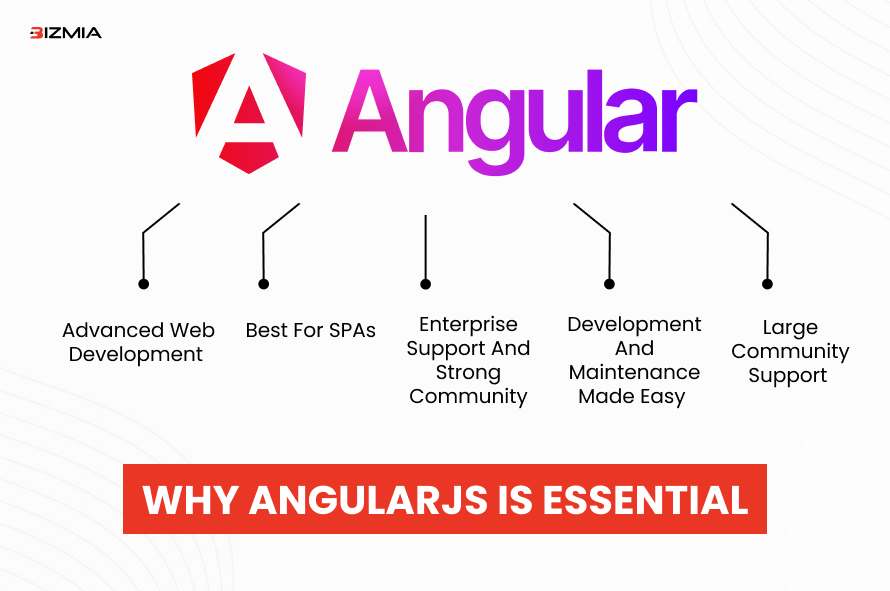
Advanced Web Development
Many advanced concepts in web development are introduced initially by AngularJS, including dependency injection, directives, and two-way data binding. These AngularJS features impacted the design of other frontend frameworks like React and Vue.
Best for building SPAs
The MVC architecture of AngularJS makes SPAs easy to handle by separating concerns. Overall development time is reduced due to automatic DOM updates and AngularJS developers can build interactive and responsive UIs efficiently.
Enterprise Support and Strong Community
As AngularJS is handled by Google, it receives security patches, extensive documentation, and continuous improvements. Also, finding solutions and tutorials has become easy due to Angular’s large community.
Development and Maintenance Made Easy
With AngularJS, complexity is minimized through declarative UI and reusable directives, modules, and services. Also, support for unit-testing and end-to-end testing to make sure your code is of higher quality.
What Makes Angular Frameworks Different from Other Frameworks
The availability of many modern web frameworks often makes developers ponder how different AngularJS is from other technologies. If you draw a ReactJS vs Angular or AngularJS vs Vue comparison, Angular and Vue are frameworks, while ReactJS is a JavaScript library.
Have a look at the given table to understand the clear difference between these three frameworks, including state management abilities, learning curve, component-based architecture, and use cases:
Key Feature | AngularJS | React JS | Vue |
Type | Framework | Library | Framework |
Language | JavaScript | JSX/JavaScript | JavaScript/ TypeScript |
Data Binding | Two-way | One-way | Two-way (optional) |
Learning Curve | Moderate | Moderate | Easy |
Component-Based Architecture | Yes | Yes | Yes |
State Management | Built-in | External | Vuex |
Practical Use Case | SPAs | Dynamic UIs | SPAs |
Vue is a lightweight framework, and React JS is flexible in nature, while Angular is an all-in-one framework, ideal for projects of moderate complexity and legacy apps.
Key Features of AngularJS
Some useful features of AngularJS include:
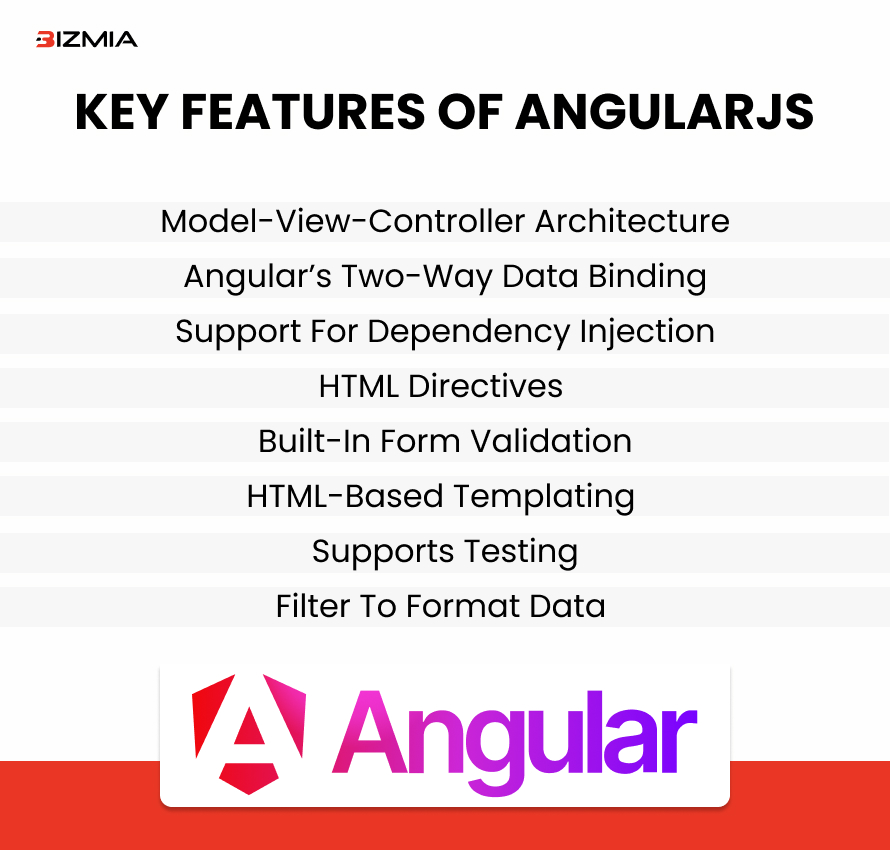
1. AngularJS MVC Architecture
AngularJS architecture is built to make the design, ensure scalability, and maintainability of web apps. It follows the Model-View-Controller (MVC) pattern. This approach divides the app into 3 components.
- First is Model: This component represents the data layer of the app, handles business logic and app data, and updates the View component when anything is altered in data.
- Second in View: This one is the UI layer, which is visible to users. View displays dynamic data from the model and uses HTML templates.
- Third is Controller: Controller behaves as an intermediate between Model and View. It is lightweight in nature and enables testing and modularity.
2. Angular’s Two-Way Data Binding
With the two-way data binding approach, AngularJS synchronizes the data between View and Model. It updates the UI automatically when any changes occur in data, eliminating the requirement of manual DOM manipulation and reducing boilerplate code.
3. Support for Dependency Injection
Dependency injections are supported by AngularJS, allowing developers to add services into components. It is useful because it makes code more modular, supports the reuse of services, and improves testability.
4. HTML Directives
These directives are custom HTML elements extending HTML capabilities. Some popular directives include ng-model, ng-if, and ng-repeat.
5. Built-in Form Validation
Built-in form validation is provided by AngularJS, which tracks form state, backs required fields, custom validations, and pattern matching. Also, it offers instant feedback.
6. HTML-Based Templating
AngularJS has HTML-based templates; it can include AngularJS directives when needed to bind data. These templates are crucial because they are responsible for making UIs declarative.
7. Supports Testing
This framework also backs unit testing and end-to-end testing and can integrate smoothly with different tools such as Karma and Jasmine. This approach helps in maintaining bug-free, high-quality apps.
8. Filter to Format Data
For data formatting, filters are used in AngularJS. Some widely used filters are data, lowercase, uppercase, and currency.
Top Advantages of AngularJS
Multiple advantages of AngularJS make it a reliable choice for businesses:
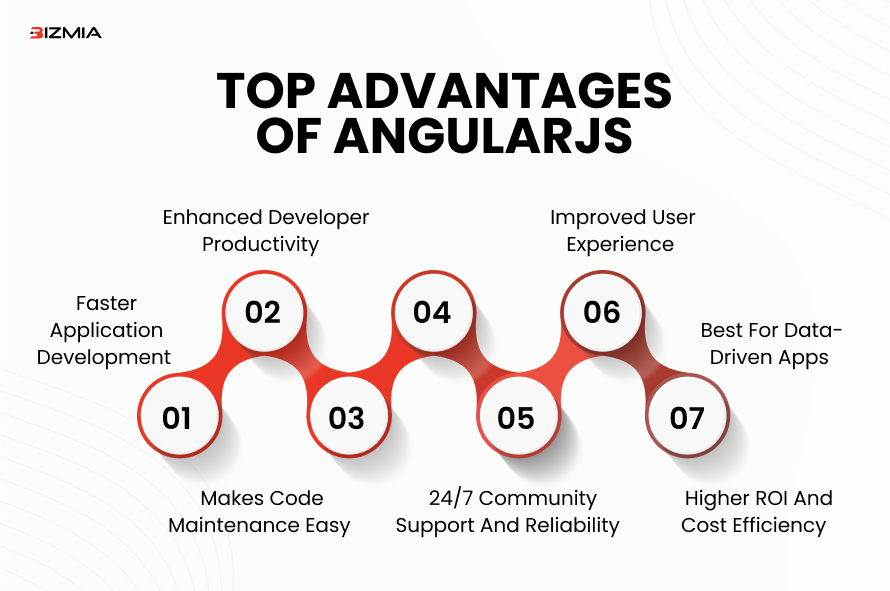
1. Faster Application Development
AngularJS development ensures fast development cycles, enabling teams to design prototypes in less time, iterate faster, and launch apps quickly. This gives brands a competitive advantage in the market.
2. Makes Code Maintenance Easy
AngularJS supports clean code organization, makes enhancements and debugging more straightforward, enabling updates without having any influence on the entire system. This way, using AngularJS saves you time and money.
3. Enhanced Developer Productivity
Here, developers can have a structured development approach so that they can work more efficiently and focus more on functionality rather than boilerplate code. Also, it improves productivity by reducing repetitive tasks.
4. Improved User Experience
AngularJS applications provide real-time UI updates, smooth navigation, avoiding page reloads, and offer responsive and interactive user interfaces. It enhances engagement and client retention.
5. 24/7 Community Support and Reliability
Being backed by Google and having a large developer community, AngularJS ensures support and faster problem-solving.
6. Best for Data-Driven Apps
Ideal framework for applications relying on user interactions, real-time data updates, and content rendering.
7. Higher ROI and Cost Efficiency
By minimizing the development time, enabling the reuse of existing components, and reducing maintenance efforts, AngularJS reduces project costs.
What is the Ideal Time for AngularJS Development
You can rely on AngularJS for:

Fast Prototyping
AngularJS keeps UI and data in sync, ensures rapid setup with minimal boilerplate code, and reusable directives to reduce coding hassle.
Applications with Moderate Complexity
Applications with moderate complexity should be dealt with AngularJS. Ideal for apps relying heavily on data, platforms in search of modularity, and projects requiring dynamic content updates.
Developing SPAs
AngularJS is the best-suited framework for designing single-page apps. That’s the reason it’s perfect for interactive web portals, CMS, and admin dashboards.
Legacy Apps and Maintenance
Companies have legacy systems built on AngularJS. They prefer this framework for maintenance or updates because shifting to a new framework may be time-consuming and costly.
When looking for a full-featured framework
Developers have a one-stop solution in the form of AngularJS with testing support, directives, templating, and dependency injection.
Reduced Cost and Development Time
Angular reduces repetitive coding via automatic DOM updates, simplifies maintenance with modular architecture, and minimizes debugging time with validation and built-in testing.
How AngularJS Development Works
AngularJS ensures a structured environment to reduce errors, boost development speed, and make coding easy.
Here’s a detailed breakdown for you to understand how AngularJS development operates:
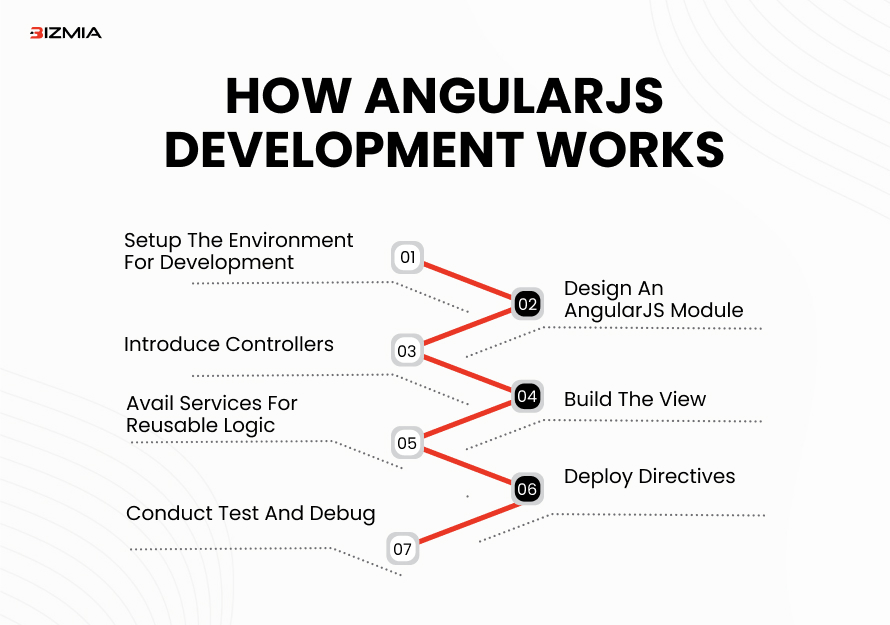
1. Set up the environment
In a project, you can include AngularJS via CDN or locally. Here’s how you can include AngularJS via CDN:
<script src="https://ajax.googleapis.com/ajax/libs/angularjs/1.8.2/angular.min.js"></script>
When Angular is included, your app is ready to start using its dynamic features.
2. Design an AngularJS Module
Create a module to define your app scope:
var app = angular.module("myApp", [ ]);
In this code example, myApp is the name of the module, and [ ] – array is for dependencies like directives or services.
3. Introduce Controllers
Controller in Angular links the Model and View and takes care of business logic. They handle API calls, data updates, user interactions, and form submissions.
Here’s an example:
app.controller("myCtrl", function($scope) {

 $scope.message = "Hello AngularJS!";

});
In this example, the message is the data bound to the HTML template, while $scope is the bridge between the view and the controller.
4. Build the View
This HTML template exhibits data to users. In the given example, ng-controller attaches the controller to the view, ng-app declares the app, and ng-model id for two-way data binding between the model and the input:
<div ng-app= "myApp" ng-controller="myCtrl">

 <h1>{{ message }}</h1>

 <input type="text" ng-model="message">

</div>
5. Avail Services for Reusable Logic
This command can be followed to build a service:
app.service("mathService", function() {

 this.square = function(x) {

   return x * x;

 };

});

Here’s how to inject into a Controller:

app.controller("calCtrl", function($scope, mathService) {

 $scope.result = mathService.square(5);

});
Through these services, code reuse and modularity are ensured to guarantee more maintainable and faster development.
6. Deploy Directives
An example of implementing the directives ng-repeat for loops through arrays and ng-if conditional rendering:
<ul>

 <li ng-repeat="item in items">{{ item.name }}</li>

</ul>
7. Conduct Test and Debug
In AngularJS, unit tests are conducted through Karma or Jasmine, and end-to-end tests are conducted to validate the entire workflows.
Proven Tips to Hire AngularJS Developers
To hire Angular developers in 2026 for your projects, follow these proven tips:
- Always search for candidates with core AngularJS knowledge.
- They should have front-end development and JavaScript development skills.
- Experience with AngularJS architecture is a must.
- Developers must be familiar with upgrades and legacy systems.
- They should always prioritize code quality.
- Must possess good communication and problem-solving skills
Wrapping Up
The dynamic capabilities of AngularJS make it an essential framework in the web development ecosystem. It gives a maintainable, efficient, and scalable solution for brands and developers alike. It is still relevant for legacy use cases in 2026. You can make your project scalable and future-ready by following the useful tips to hire Angular developers and getting benefits from this technology.