
To build strong applications and websites in 2026, it’s important to master full-stack development. If you are planning to build your career as a full-stack developer and have no clue “what is a full-stack developer”, “where to start from”, “what technical skills you can develop”, or “what are the career prospects”, you are in the right place. Full-stack developers are experts in both backend and front-end development. They also bring creativity, innovation, and problem-solving capabilities to align the functionality and design of projects. This guide will break everything down in a practical and user-friendly way.
Let’s give a read!
What is Full Stack Development?
The entire process of developing, maintaining, and managing a web app, from coding to launch, is known as full-stack development. It encompasses everything behind the scenes, including what users see, as well as the infrastructure. It’s a complete process involving:
Frontend Development
It includes buttons, layouts, forms, animations, images, responsive behavior on mobile, and navigation menus, in short, everything users come into interaction with. The top frontend frameworks include Angular, React, Vue.js, and other languages like CSS and JavaScript. With these tools, web developers build scalable, fast, and dynamic UIs.
Backend Development
It handles authorization, authentication, business logic, security, performance optimization, and data processing. The most popular backend frameworks or technologies include Laravel, Node.js, Django, and Ruby on Rails.
Understanding how to build RESTful APIs, optimize performance, secure apps, and handle authentication tokens is essential for full-stack developers.
Database Handling
Database designing, management, and querying are part of full-stack development. The two major database types are MySQL databases and NoSQL databases. Developers should master data modeling, query optimization, indexing, schema design, and data security to build the best applications.
APIs and Integrations
Integration with payment gateways, analytical tools, social media platforms, third-party services, or authentication providers is essential for modern apps. For full-stack development, experts design and consume APIs to integrate smoothly with systems.
Cloud Infrastructure and Deployment
Once an app is designed, its deployment and maintenance are crucial. Skilled full stack developers know cloud hosting, scaling, load balancing, server configuration, and continuous integration. Some common cloud platforms are Google Cloud, Microsoft Azure, and Amazon Web Services.

What is a Full Stack Developer? An Introduction
Software engineers who are well-versed in both the backend and the frontend of an app are full-stack developers. They can build logic that runs behind the scenes, develop user interfaces, deploy the app to the cloud, and improve and maintain the whole system. It indicates that they work across all layers of web development. Companies need developers who can develop fast, optimize performance, scale systems, minimize development costs, think strategically, and adapt to new tools. For enterprises and startups, a full-stack web developer brings versatility.
What Full-Stack Developers Do?
Skilled full-stack developers are responsible for developing, improving, and handling complete web apps. They handle:
- User interfaces
- Server-side logic
- Debugging and testing apps
- Cloud deployment
- Development and integration of APIs
- Collaborations with cross-functional teams
- App security
- Performance optimization
Here is a typical workday snapshot of a full-stack developer for your understanding:
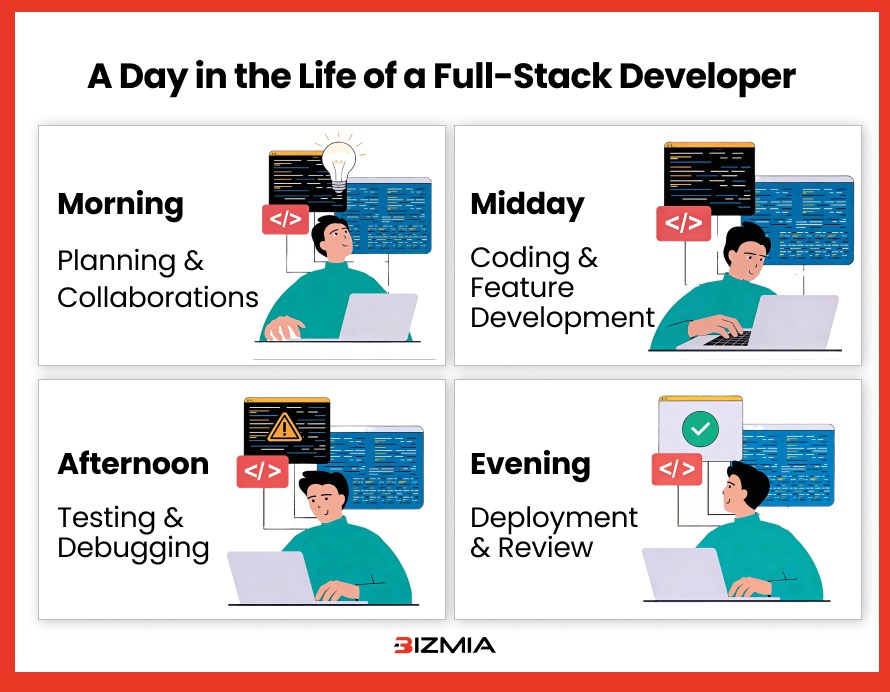
Useful Skills You Need to Learn as A Full-Stack Developer
1. Handle Frontend Development
A brilliant full-stack developer should be skilled in client-side development from basic coding concepts to advanced front-end technologies. They should know HTML (for structure), CSS (for layouts, typography, animations, and colors), and JavaScript (to ensure interactivity).
2. Build Expertise in Backend Development
For smooth backend development, web developers must understand API creation, error management, business logic handling, authentication systems, and server architecture. To hire web application developers, companies look for strong debugging abilities, clean separation of concerns, scalable architecture, secure authentication, and RESTful API design.
3. Develop Database Management Abilities
Top database management skills include data modeling, data security, schema design, indexing, and writing optimized queries. Your app may suffer when database decisions are not taken wisely.
4. Learn Version Control
For advanced web development, in-depth knowledge of Git, code reviews, conflict resolution, pull requests, and branching strategies is critical. Developers having expertise in handling GitHub or GitLab platforms are more likely to get hired fast. Good collaboration skills make teamwork easy.
5. Deployment and Cloud Scaling are A Must
Understanding environmental variables, CI/CD pipelines, load balancing, and application scaling is a plus. Full-stack developers are also proficient in Docker basics and server configuration. It is also good to comprehend deployment workflows.
6. Security Compliance Should be the Priority
Full-stack developers should implement input validation, HTTPS encryption, protection against SQL injections, and XSS. Also, data encryption, secure authentication, and role-based access control are useful for building secure apps.
7. Soft Skills Build Credibility
Polishing your problem-solving abilities, adaptability, communication skills, and time management is required for smooth development. Understanding user behavior and product thinking is also recommended. Companies in the USA usually hire those developers who understand business impacts well.
8. Consistent Learning is A Plus
Developers must follow tech blogs, experiment with the latest AI tools, upgrade their stack regularly, develop side projects, and contribute to open source. So that they can learn and upgrade their knowledge with new advancements.

10 Step Guide to Becoming a Full-Stack Developer in 2026
Follow this easy guide to get your dream job in 2026:

1. Learn Basic Computer Science Concepts
You can focus on these coding concepts: algorithms and data structures, basics of version control (Git/GitHub), Object-oriented programming, networks, and operating systems. Also, work on your problem-solving abilities and computational thinking.
Having a strong grip on key coding concepts helps in choosing the best programming languages for projects. You can learn all these concepts through university programs, coding bootcamps, or online courses.
2. Practice Frontend Development Skills
To keep up with the latest frontend development trends and gain expertise, learn HTML, JavaScript, and CSS. Then build small development projects, such as a to-do application or website, to polish your frontend skills.
3. Focus on Backend Development Tasks
Learn server-side languages (Laravel, Django, and Node.js), API development, and how to work with databases. Also, you can master performance optimization, security, and authentication. To sharpen your backend development skills, you can build a backend for small web applications and then connect them with the frontend part.
4. Work on Data Management and Databases
For efficient database management, focus on NoSQL, MySQL, query optimization, data modeling, security, backup, and data integrity. To have hands-on learning, you can experiment with CRUD operations.
5. Do Collaborations on Tech Platforms
Learn how to collaborate via GitHub or GitLab, pull requests and code reviews, merging and branching strategies, and Git version control. For real-world experiences, you should also contribute to open-source projects.
6. Learn Cloud Deployment
To successfully deploy your apps, focus on learning about popular cloud platforms, containerization with Docker, environmental variables, server management, monitoring and scaling apps, and continuous integration and continuous deployment (CI/CD).
7. Take up Practical Projects
Demonstrate your technical skills by developing portfolio websites, RESTful API services, Blogging or content management systems, messaging or social media platforms, and E-commerce applications with payment integration.
8. Practice Technical Interview Questions
To get a dream job placement, you should practice with common interview questions, including coding challenges, API integration tests, live coding sessions, system design questions, and algorithm problem-solving.
9. Stay Updated with New Technologies
You can stay updated with constantly evolving tech frameworks by following tech blogs, YouTube videos, attending webinars, workshops, hackathons, or joining developer communities on LinkedIn, Discord, or Reddit.
Once you get done with easy languages, you can continue progressing with the hardest programming languages to become a pro at programming.
10. Do Certifications
Once you are established, you can boost your credibility with the top certifications that include full-stack developer professional certificates, IBM Generative AI for Software specialization, and more.
Full-Stack Development Issues
Full-stack web development is not so easy, and here are some common issues that you might face during the process:
- There can be context switching between the backend and frontend.
- Complex integrations become difficult to handle
- Not so easy to avoid burnout
- Striking a balance between quality and speed is taxing.
- Difficulty in keeping up with the modern web development frameworks
However, with careful and effective development strategies, you can fix these issues.
Cost of Hiring Full Stack Developers in the USA?
Being a full-stack developer is a lucrative career option for tech professionals in the United States. Here’s a pricing breakdown from junior to senior-level career roles:
Developers | Salary |
Junior Developer | $70,000 to $90,000 |
Mid-Level Developer | $90,000 to $120,000 |
Senior Developer | $120,000 to $160,000 |
Lead/Architect | $150,000 to $180,000+ |
Developers may get additional perks depending on the brand they are associated with. These perks include stock options or equity, bonuses based on performance, health insurance, paid training, certifications, or remote work flexibility.
Wrapping Up
To become a full-stack developer, you go beyond learning programming languages and frameworks. It’s more about developing problem-solving abilities, adaptability with the latest tech stacks, and a versatile mindset. You don’t just write code; you optimize performance, build solutions, and connect each layer of the full-stack development. Whether you want to launch your own company, design innovative apps, or aim to get your dream position at a renowned brand, mastering full-stack development skills is the key.