

If you are figuring out how to hire PHP developers for your web projects in 2026, you are not alone. Thousands of companies worldwide struggle every year to get the best talent. Some hire fast, and others waste months interviewing and selecting experts…and regret it. The point is to hire the right professional for your project, not just high-quality PHP programmers. As PHP remains one of the top choices for building scalable applications, there is a search for PHP experts.
If you are planning to develop a SaaS platform, create custom enterprise software, build high-performance APIs, or modernize legacy PHP systems, or scale WordPress or Magento, then hiring suitable PHP developers influences security, scalability, speed, and maintenance.
This in-depth guide explains how to hire PHP developers step-by-step, associated costs, and common mistakes to avoid.
Why PHP Still Matters in 2026
PHP is still relevant in 2026, as over 70% of server-side websites are powered by PHP; it’s highly dominant in e-commerce and SaaS platforms due to its massive ecosystem and cost efficiency. PHP is truly evolving with time. That’s the reason you should know how to smoothly hire PHP developers to stay updated, relevant, and build projects successfully, because PHP remains a top choice for web development in 2026 and years to come.
How to Identify the Best PHP developers for Your Projects?
Before you plan to hire PHP web developers, you should clearly define what level of experience and technical expertise you need and how long you need a developer, depending on your project’s timeline.
Here’s a complete breakdown of developer types ideal for your project based on their skills. Have a look and pick the right talent:
Developer Type | Best Fit For | Skill Focus |
Backend PHP Developer | APIs | Server-side architecture |
Full-Stack PHP Developer | End-to-end builds | PHP |
WordPress Developer | CMS projects | Themes |
Laravel Developer | SaaS | MVC architecture |
Magento Developer | eCommerce | Payment |
PHP Experts (Architect Level) | Enterprise systems | Scalability Optimization |
How to Hire PHP Developers: 7 Step Process
Now that you are aware of PHP’s importance and know what expertise you need, let’s learn how you can hire PHP programmers smoothly by spotting the right talent:
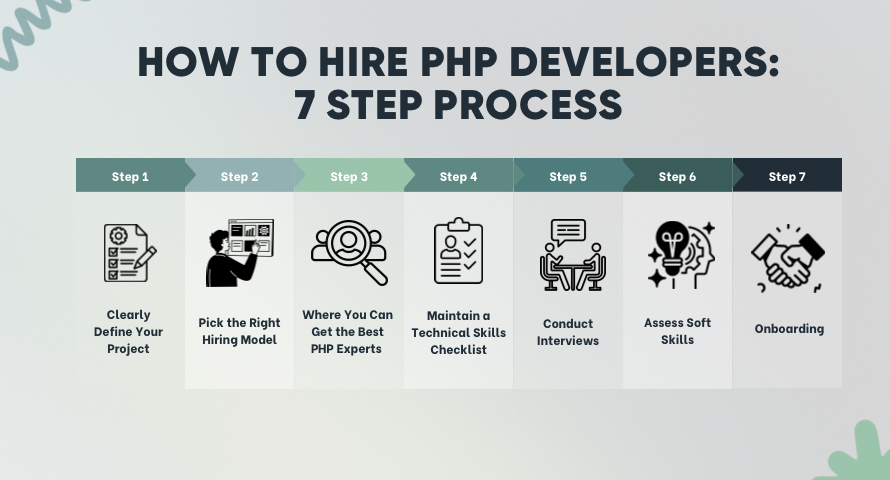
Step 1: Clearly Define Your Project
You should always clearly define your requirements; what tasks must be done, the best PHP frameworks developers should know, and what your goals are. For example, you can write like this in a job description:
“We are looking for Laravel developers to optimize API performance for a 1-year performance-based contract.”
Step 2: Pick the Right Hiring Model
A suitable hiring model determines cost, control, and hiring speed. Depending on your project demand, timeline, budget, or skills required, you can choose to hire the best PHP developers:
- Freelance PHP developers
- In-house full-time PHP developers
- Dedicated remote PHP developers
- PHP development agency/ Team Model
Hiring Model | Ideal For | Benefits | Limitations |
1. Freelance PHP Developers | Small fixes | Lower upfront cost | Availability inconsistency |
2. Dedicated Remote Developers | Startups | Scalable | Needs process management |
3. In-House PHP Developers | Enterprise systems | Full control | High salary |
4. Agency / Team Model | Full product builds | Faster execution | Higher cost |
2026 USA Hiring Insights
Startups prefer remote dedicated developers; enterprises choose hybrid models (remote and in-house), and development agencies work best with full-time developers.
Step 3: Where You Can Get the Best PHP Experts
To find the best talent pool, you can look at:
- Stack Overflow
- GitHub
- Freelance marketplaces like Upwork or Fiverr
- Multiple talent networks for pre-vetted experts
While checking profiles, always review GitHub repositories, code structure, documentation quality, and contribution frequency in projects.
Step 4: Maintain a Technical Skills Checklist
It’s totally outdated to hire PHP developers based on experience. Here’s what you can look for in a potential candidate, including expertise in top PHP frameworks, database optimization capabilities, OOP, advanced-level knowledge, testing, and a lot more:
Skills | Must-Have? | Importance |
1. PHP 8+ Knowledge | Yes | Performance & modern features |
2. OOP | Yes | Clean architecture |
3. PHP Framework Expertise | Yes | Faster development |
4. REST API Development | Yes | Modern app ecosystem |
5. Database Optimization | Yes | Performance |
6. Security Best Practices | Yes | Risk mitigation |
7. Composer Dependency Management | Yes | Project stability |
8. Testing (PHPUnit) | Recommended | To fix bugs |
Step 5: Take Interviews
After shortlisting the candidates with suitable profiles, you can conduct formal interviews to evaluate their technical skills. You may assess all technical abilities, starting from basic coding concepts to OOP and SQL Injection knowledge. Also, you can give them tasks like code refactoring, performance optimization, debugging tasks, or small REST APIs.
Step 6: Soft Skills Evaluation
Despite being technically sound, PHP developers may miss deadlines, ignore documentation, can’t explain technical tradeoffs, or might not understand business goals. To evaluate soft skills, you may ask business-focused questions: can they simplify complex concepts, suggest, or what they think about scalability.
Step 7: Smooth Onboarding
After the interview, you can select the candidate who perfectly fits your project requirements. Offer them a milestone-based contract and onboard them with clear Key Performance Indicators (KPIs).
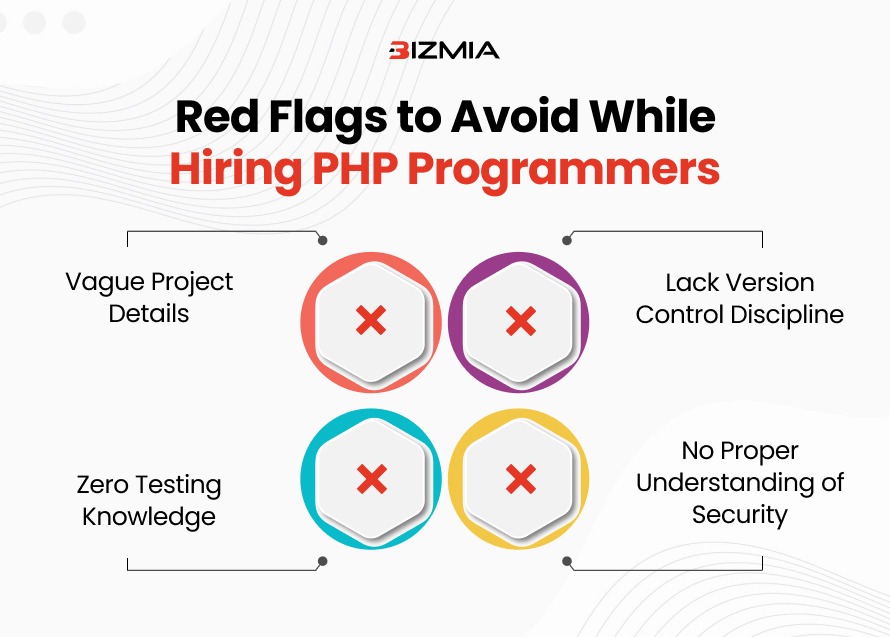
Some Red Flags to Watch Out for While Hiring PHP Programmers
Here are some red flags that you should be concerned about while hiring PHP web developers:
1. Unclear Project Details
If a developer talks about multiple projects which he handled but can’t clearly explain the associated scaling challenges, architecture decisions, and performance bottlenecks. Also, if they don’t understand database structure properly, that is a complete red flag.
2. Lack Version Control Discipline
Professional PHP developers leverage GitHub branching strategies, structured commits, and pull request review. If they avoid code reviews, don’t use GitHub, or can’t explain a merge conflict, that’s a put-off.
3. No Proper Understanding of Security
If you ask potential candidates about how they would prevent SQL injection, and if they answer that they use prepared statements, that is not wholesome. A skilled PHP programmer should implement input validation, ORM safeguards, rate limiting, output escaping, and CRM protection.
4. Zero Testing Knowledge
If a developer has never used Unit testing, PHPUnit, or integration testing methods, companies have to face issues later in debugging time. That’s not what they need; for advanced PHP projects, structured PHP testing practices are required.
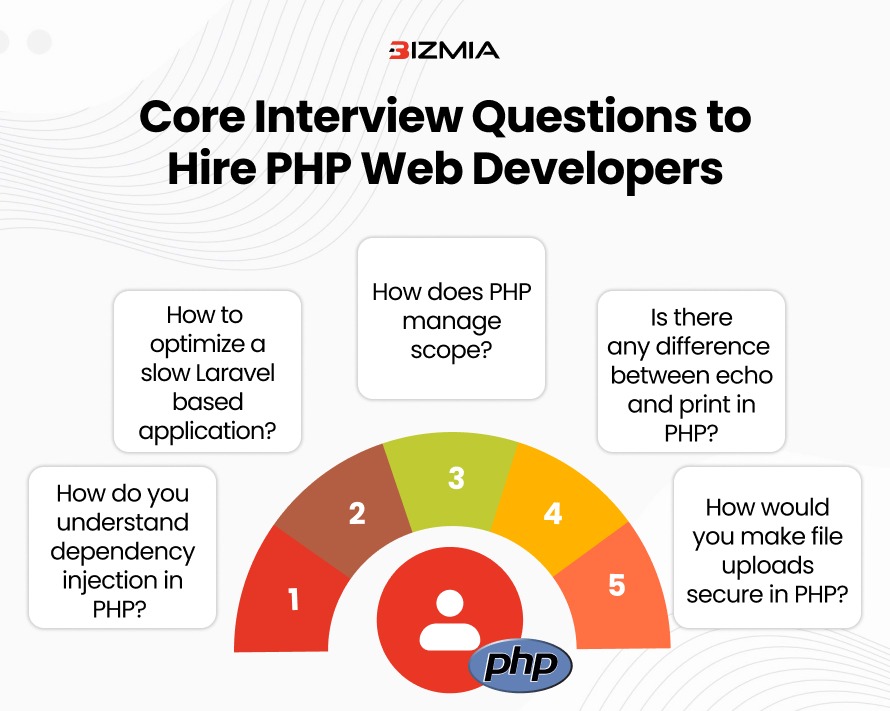
Top Interview Questions to Hire PHP Web Developers
Here’s a list of questions that you can ask as a recruiter of PHP developers you want to hire:
How do you understand dependency injection in PHP?
A strong developer’s answer should include cleaner architecture, improved testability, decoupling components, and examples in Symfony or Laravel.
How to optimize a slow Laravel-based application?
An experienced developer should know about database indexing, caching, queue handling, profiling tools, lazy loading vs eager loading, and query optimization. Also, they should understand and explain performance management first.
How does PHP manage scope?
A suitable answer to this question must include static keyword discussion, closures, and global vs local scope.
Is there any difference between echo and print in PHP?
PHP experts should explain that echo outputs without returning a value, and it is slightly faster. While print returns, 1. This exhibits their attention to detail.
How would you make file uploads secure in PHP?
A strong answer must include MIME type checking, file size restriction, virus scanning, renaming files, and storing outside the public directory. Security knowledge is necessary for production systems.
Other than these questions, you can also ask if they are skilled in other web development languages or not. If they can draw a comparison like Python vs PHP, or of another language with PHP. What modern tools do they know. This would help you check overall programming knowledge.
PHP Developers Hiring Costs in 2026
Here’s an experience-based pricing breakdown of hiring PHP developers in the USA:
Experience Level | Hourly charges (USA) | Annual Equivalent |
Junior PHP Developer | $25 to $40 | $55k to $75k |
Mid-Level PHP Developer | $40 to $75 | $80k to $120k |
Senior PHP Developer | $80 to $150 | $130k to $180k+ |
Architect or PHP Experts | $150+ | $180k to $220k+ |
Although the selection of a PHP expert totally depends on your project requirements, timeline, and budget. An average developer usually thinks about how things work. However, elite PHP developers ponder if a project is secure, maintainable, scalable, and optimized or not.
When Should You Shift from Freelance PHP Developers to an In-House Team?
From freelance PHP developers, you can shift to a dedicated full-time development team if:
- Your monthly development hours exceed 120
- Backend coordination and DevOps are required.
- You follow a continuous feature roadmap.
- Compliance with security standards is crucial.
6 Common Mistakes When Taking PHP Developers Onboard
Poor onboarding decisions and management can lead to high turnover, developer frustration, security vulnerabilities, performance issues, and slower feature releases.
Here are 6 common onboarding mistakes that can cause you trouble and how you can fix them for smooth development:

1. Experience = Skills
If you believe that many years of experience are enough to assess capability, that’s not true. A person having over 5 years of experience doesn’t guarantee security awareness, performance optimization, scalability planning, clean coding standards, or architectural thinking.
To avoid this misunderstanding, always evaluate critical thinking, not just tenure, ask technical questions, assign practical tasks, or review real code samples.
2. Not Focusing on Advanced PHP Frameworks
Without having a proper knowledge of modern PHP frameworks, you risk repetitive logic, poor code organization, difficult maintenance, or higher technical debt. To fix such issues, make sure your experienced PHP developers know caching mechanisms, implement authentication workflows properly, can elaborate service containers, and understand the whole modern framework architecture.
3. No technical interviews
If you rely completely on resumes and don’t have technical validation, you can’t assess debugging approaches, problem-solving ability, security awareness, or optimization skills. Never rely on profiles of referrals and always conduct interviews, review GitHub or code repositories, and test if they have skills and are open to best programming languages to learn.
4. No clear onboarding plan
Lack of a clear onboarding plan may result in low productivity in the first 60-90 days, security misconfiguration, or repeated mistakes. It may also cause disengagement, leading to frustration.
Make a strong onboarding plan for 30, 60, and 90 days by gradually assigning tasks.
5. No strong documentation
With weak documentation, new hires struggle, refactoring can be risky, or bugs may increase. Avoid this blunder by maintaining API docs, coding standard manuals, deployment guides, database schema documentation, and security guidelines.
6. No performance benchmarks
Skipping proper benchmarks can make you lose out on API response time, server load, caching efficiency, memory usage, or database query speed. Instead, you should encourage experts to use caching strategies, log analysis, monitoring dashboards, load testing, or query profiling.
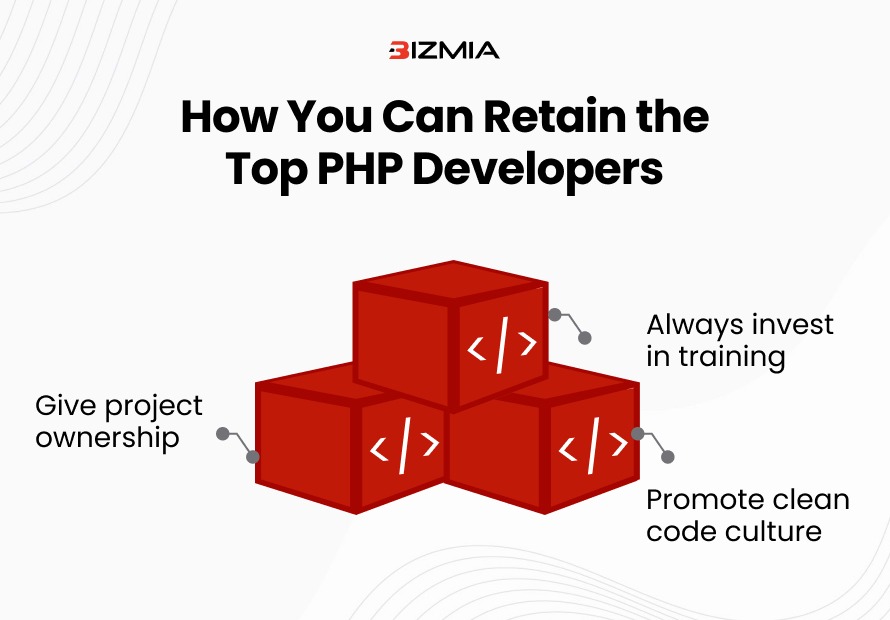
How You Can Retain the Top PHP Developers
By now, you understand well how to hire PHP developers for suitable pricing and what mistakes to avoid for smooth hiring; let’s learn some proven tips on how you can retain that top talent for your brand:
- Give project ownership, not just commands.
- Always invest in training and support cloud certifications, advanced architecture courses, and performance optimization training.
- Promote a clean code culture by using code reviews, automated testing, documentation standards, and GitHub workflows.
Wrapping Up
Finding the perfect PHP talent is a strategic decision for you as it directly impacts scalability security, and long-term success of your project. Hiring is a critical process, and to ensure a smooth one, you should follow each step carefully and avoid blunders associated with. Now let’s onboard the best PHP experts for your upcoming project.