

If you are planning to build scalable, fast, and maintainable applications, you should have a clear knowledge of “what is OOP and how does it work?” Java is a programming language developed around OOP principles. OOP concepts in Java are a programming paradigm that develops software around objects. These objects are the entities that combine behavior and data. With object-oriented programming in Java, developers can reuse code, organize it effectively, model real-world systems, and enhance project scalability.
This comprehensive guide explains all the key OOP concepts in Java, with code snippets and real-world use cases; give it a read to have a strong command over programming.
What is OOP?
A programming paradigm that builds software through objects rather than depending on procedural logic or functions is Object-Oriented Programming (OOP). Developers design programs that resemble real-world entities that they are trying to replicate as models.
Further, in OOP, an object is a basic unit of software. It combines two basic coding concepts or components: data and behavior.
Data represents properties or attributes like color, speed, or brand of a Car object. While behavior defines those operations that can be performed by that specific object, for example, a Car object method can be ‘stop ()’, ‘start ()’, or ‘accelerate ()’.
OOP, meaning in Java, is developing programs via objects, making projects easier to build, maintain, and scale.
Useful Features of Java That Support Object-Oriented Programming
Being primarily an object-oriented language, key features of Java include class-based structure, platform independence, encapsulation, inheritance, abstraction, and polymorphism:
Java Features | Explanation |
1.Class-Based Structure | Programs are developed through classes |
2.Platform Independence | The “Write Once, Run Anywhere” approach enables objects to operate across various platforms. |
3.Encapsulation | Data can be hidden with access modifiers; it protects the object’s internal state. |
4.Inheritance | Classes can inherit methods and properties from parent classes, promoting code reuse. |
5.Polymorphism | The same method can behave differently depending on the object that calls it. |
6.Abstraction | Details of deployment can be hidden, exposing only those functionalities that are necessary. |
Here’s an example of how Java features enable OOP:
class BankAccount {

  private double balance; // Encapsulation

  public BankAccount(double balance) { // Constructor

      this.balance = balance;

  }

  public void deposit(double amount) { // Method

      balance += amount;

  }

  public double getBalance() { // Getter method

      return balance;

  }

}
In this example, as a class-based structure, BankAccount is a blueprint for all bank accounts, and as real-world modelling, it represents bank accounts in the software.
Basic OOP Concepts in Java
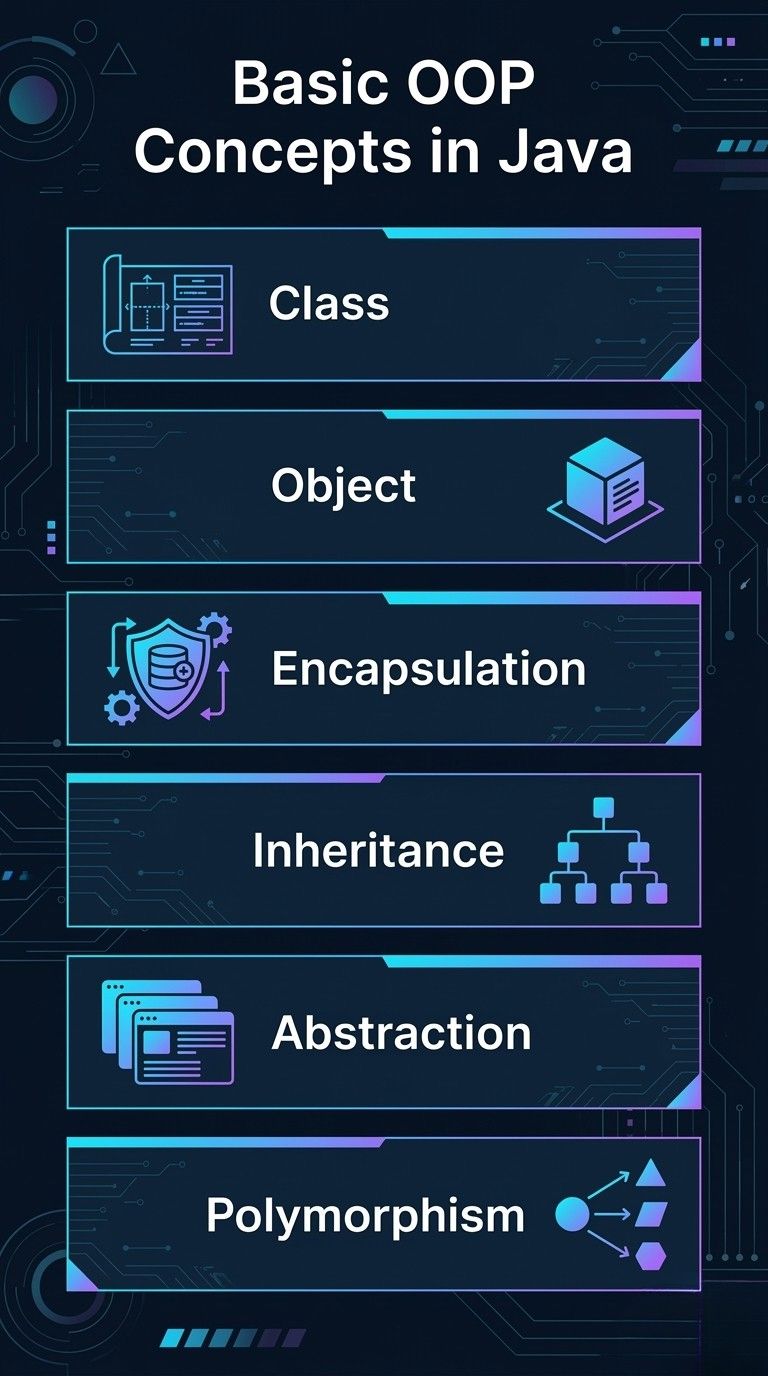
Let’s decode ‘what are the OOP concepts in Java?’, and why they are useful for writing scalable, maintainable, and clean code for your projects:
1. Class
For building objects in Java, a class acts as a blueprint. It clearly defines the methods and properties of the objects of that class. In simple words, you can say it’s a template for real-world entities.
In this example Car is the class name, drive () is the specific method, and speed and brand are the attributes. You may follow this:
class Car {

  String brand;

  int speed;

  void drive() {

      System.out.println("Car is driving");

  }

}
In the real world, this class is a blueprint for constructing houses, helping you to follow the exact design and create multiple houses.
2. Object
The instance of a class is called an object; they exhibit real-world entities. Objects have behavior, identity, and state. This example shows car1 is an object of class Car:
Car car1 = new Car();

car1.brand = "Toyota";

car1.speed = 120;

car1.drive();
3. Encapsulation
The entire procedure of wrapping methods and data into a single unit is described as encapsulation. It also involves restricting direct access to a few components. This way, encapsulation handles controlled access and data security.
Java developers declare class variables as ‘private’ and give ‘public’ getter and setter functions.
Here’s an example where ‘age’ is private, ‘setAge ( )’ and ‘getAge’ offer controlled access:
class Student {

  private int age;

  public void setAge(int age) {

      this.age = age;

  }

  public int getAge() {

      return age;

  }

}
Apart from protecting data, encapsulation boosts maintainability and improves control and security of data.
4. Inheritance
One of the basic concepts of OOP in Java is inheritance. Through inheritance, a class inherits its methods and properties from another parent class. It minimizes redundancy and promotes code reuse. In the given example, Animal is the parent class, and Dog is the subclass:
class Animal {

  void eat() {

      System.out.println("Animal eats");

  }

}

class Dog extends Animal {

  void bark() {

      System.out.println("Dog barks");

  }

}
The various types of in Java are:
- Single Inheritance: In single inheritance, one child class inherits from one parent class.
- Multilevel Inheritance: In multilevel inheritance, properties and methods are inherited from one child to another.
- Hierarchical Inheritance: One parent is there, and multiple subclasses inherit from it.
- Hybrid Inheritance: Hybrid inheritance combines various types of inheritance using interfaces.
5. Abstraction
With abstraction, it becomes possible to hide complex details of implementation and show only which are essential. Users interact with simple interfaces, avoiding the complexities of internal logic. In Java, for partial abstraction, there’s Abstract classes, while full abstraction is conducted through interfaces.
Here’s an example of an abstract class defining behavior, implementation is carried through a subclass:
abstract class Animal {

  abstract void sound();

}

class Dog extends Animal {

  void sound() {

      System.out.println("Dog barks");

  }

}
6. Polymorphism
As the name indicates, polymorphism means “many forms”. In Java, Polymorphism enables the same object or method to act differently based on context. Broadly, there are two types of Polymorphism:
a-Compile Time Polymorphism
This type of polymorphism occurs when different methods have the same name, but their parameters differ.
class MathOperation {

  int add(int a, int b) {

      return a + b;

  }

  int add(int a, int b, int c) {

      return a + b + c;

  }

}
b-Runtime Polymorphism
Runtime polymorphism happens when a subclass overrides a method, as the call resolves at runtime.
class Animal {

  void sound() {

      System.out.println("Animal makes sound");

  }

}

class Cat extends Animal {

  void sound() {

      System.out.println("Cat meows");

  }

}
Key Benefits of Object-Oriented Programming
Companies hire Java developers to get the benefits offered by OOP programming in Java:
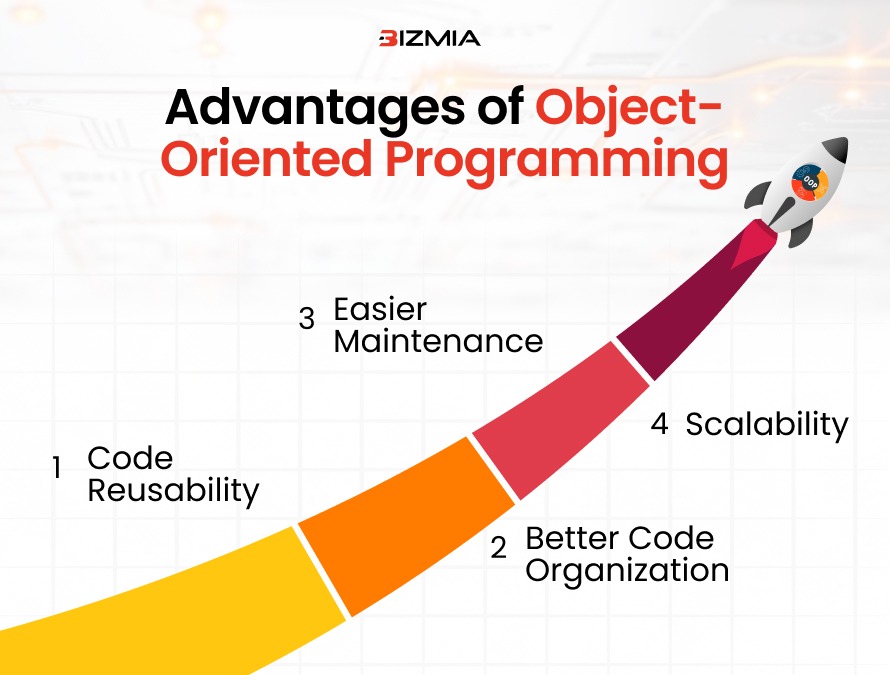
Reusability of Code
Developers are enabled to reuse objects and classes across various programs with OOP. With the help of already existing classes, developers build new objects, making development more efficient.
Code Organization made better
OOP allows dividing programs into logical units that are classes. This way, you make code easier and more structured.
Maintenance and Scalability
With separate classes, it gets far easier to test, debug, and update code.
Real-World Models
Your software is allowed to mimic real-world entities through OOP; this makes curating and managing complex tasks easier.
Disadvantages of OOP Concepts in Java
Besides its many advantages, OOP has some drawbacks, including:
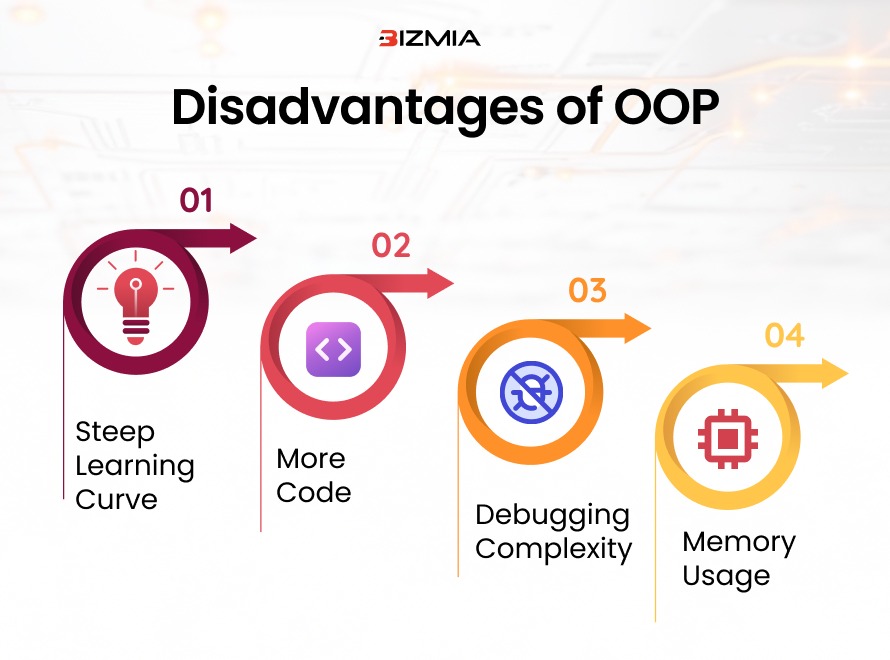
- A steep learning curve due to its abstraction, polymorphism, and encapsulation.
- With OOP, you need additional boilerplate code for objects, methods, and classes.
- It may become more difficult with multiple inheritance layers and classes.
- With limited resources, developing multiple projects, memory usage increases.
Practical Use Cases of OOP Principles in Java
In real-world software development, OOP concepts in Java are widely used for:
- Enterprise software systems
- Web apps
- Android Application Development
- Game development
- Banking Apps
Some Common OOP Concepts in Java Interview Questions
During technical interviews, Java developers are usually asked various questions about OOP concepts in Java. Some commonly asked questions are:
- What is polymorphism in Java programming?
- What is class and inheritance in Java?
- Is there any difference between Encapsulation and Abstraction?
Wrapping Up
For seasoned developers and newbies alike, mastering OOP concepts in Java is crucial for faster and scalable application development. The core OOP principles include class, object, encapsulation, abstraction, inheritance, and polymorphism to assist developers in building reusable, scalable, and structured apps. They also enable Java experts to model real-world systems, reduce redundancy, improve maintainability, and prepare them for their technical Java interviews.