

AI personalization is shifting the way Shopify stores sell, retain customers, and engage with them. Just a few years ago, online shopping was primarily about browsing static catalogs, manually searching for products, and comparing prices. Today, shoppers expect online brands to anticipate their needs before they even search for desired products. They want curated collections, personalized recommendations, and smooth shopping experiences. And if your Shopify store doesn’t offer it, they quickly move to the competitor who does.
This is where AI personalization comes into play. Artificial intelligence (AI) in no longer be a buzz word in 2025; it is the power behind successful e-commerce giants globally. Just think about Spotify curating your favorite playlists or Netflix recommending your next favorite show, or Amazon suggesting add-on products-everything relies on AI personalization.
Now in 2025, all Shopify store owners can access all these tools. Through AI personalization for Shopify with a trusted Shopify development agency, all brands, even smaller ones, can turn their stores into sales machines.
Why AI Personalization Matters Today
A report by McKinsey says that AI personalization can drive a 10% to 15% revenue uplift across multiple industries, and e-brands focusing on personalization can generate 40% more ROI than their peers. On the flip side, if your Shopify stores don’t use AI-driven personalization strategies, you are leaving money on the table.
From One-Size-Fits-All to One-Size-Fits-One Approach
In traditional marketing setups, broad customer segments matter. Merchants usually group customers by age, gender, or income and send generic promotional campaigns. However, these days, customers want something more precise. They want stores to recognize their preferences in real-time and design a truly personalized journey. AI makes this possible for shoppers by:
- Gathering and analyzing customer data at scale
- Spotting hidden patterns in shopping behavior
- Instantly delivering promotion, customized recommendations, and experiences.
Role of AI in Personalization
AI is not just a modification to personalization-it’s the main driver that makes a 1:1 shopping experience possible. It acts as the brain behind storefronts for retailers. Let’s understand why AI is essential for personalization:
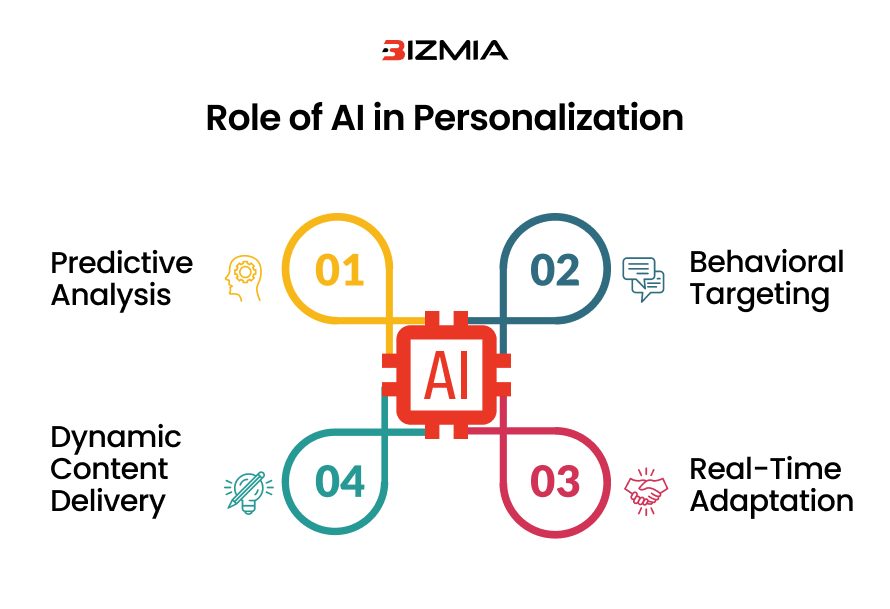
1. Predictive Analysis
AI can predict future behavior based on past actions-it’s one of the most powerful roles of AI in personalization. For example, if a shopper buys running shoes, AI can predict he may need sportswear, socks, or fitness trackers. Another example can be: if a user mostly purchases eco-friendly products, in future searches, AI will suggest sustainable alternatives. This way, personalization has changed from being reactive to proactive.
Key Stats: As per Deloitte, predictive personalization can enhance customer retention by 15% and acquisition by 20%.
2. Behavioral Targeting
Artificial Intelligence doesn’t just look at what users buy-it understands why they buy. AI can give precisely targeted offers and content by analyzing time spent on pages, click-through behavior, and browsing habits.
Examples include giving budget-friendly product options to price-sensitive customers, providing premium upgrades for high-spending shoppers, and offering personalized discounts to frequent cart abandoners.
This scale of targeting not only makes clients feel valued and understood but also boosts conversions.
3. Dynamic Content Delivery
AI-driven personalization enables customers to deliver content that alters based on user context. It includes:
- Customized banners promoting new arrivals in the user’s favorite category
- Personalized pop-ups offering exclusive discounts
- Tailored landing pages that adapt to traffic sources
4. Real-Time Adaptation
Artificial Intelligence personalization is immediate and dynamic. It’s in contrast with traditional personalization methods that rely on pre-set rules, AI adapts in real-time:
- If a person starts browsing for summer dresses, the homepage can adjust to show seasonal collections.
- With real-time bundle suggestions, AI can upsell during checkout.
- This agility makes your shopping journey relevant and fresh.
Why is it Essential for Shopify Stores
The role of AI in personalization is all about efficiency and scalability. It’s impossible to tailor shopping experiences manually for hundreds or thousands of customers-however with AI, retailers can scale personalization easily, improve customer satisfaction with relevant interactions, repeat purchases, and drive higher site conversions.
Role of AI in Personalization
AI is not just a modification to personalization-it’s the main driver that makes a 1:1 shopping experience possible. It acts as the brain behind storefronts for retailers. Let’s understand why AI is essential for personalization:
1. Predictive Analysis
AI can predict future behavior based on past actions-it’s one of the most powerful roles of AI in personalization. For example, if a shopper buys running shoes, AI can predict he may need sportswear, socks, or fitness trackers. Another example can be: if a user mostly purchases eco-friendly products, in future searches, AI will suggest sustainable alternatives. This way, personalization has changed from being reactive to proactive.
Key Stats: As per Deloitte, predictive personalization can enhance customer retention by 15% and acquisition by 20%.
2. Behavioral Targeting
Artificial Intelligence doesn’t just look at what users buy-it understands why they buy. AI can give precisely targeted offers and content by analyzing time spent on pages, click-through behavior, and browsing habits.
Examples include giving budget-friendly product options to price-sensitive customers, providing premium upgrades for high-spending shoppers, and offering personalized discounts to frequent cart abandoners.
This scale of targeting not only makes clients feel valued and understood but also boosts conversions.
3. Dynamic Content Delivery
AI-driven personalization enables customers to deliver content that alters based on user context. It includes:
- Customized banners promoting new arrivals in the user’s favorite category
- Personalized pop-ups offering exclusive discounts
- Tailored landing pages that adapt to traffic sources
4. Real-Time Adaptation
Artificial Intelligence personalization is immediate and dynamic. It’s in contrast with traditional personalization methods that rely on pre-set rules, AI adapts in real-time:
- If a person starts browsing for summer dresses, the homepage can adjust to show seasonal collections.
- With real-time bundle suggestions, AI can upsell during checkout.
- This agility makes your shopping journey relevant and fresh.
Why is it Essential for Shopify Stores
The role of AI in personalization is all about efficiency and scalability. It’s impossible to tailor shopping experiences manually for hundreds or thousands of customers-however with AI, retailers can scale personalization easily, improve customer satisfaction with relevant interactions, repeat purchases, and drive higher site conversions.
Key Components of AI Personalization
AI-driven personalization is not just a single feature. It’s a package of interconnected components. These components work together to give highly customized shopping experiences. Understanding of these components is crucial for Shopify store owners to choose the right AI strategies, tools, and integrations.
Let’s have a look at the key pillars of AI personalization:
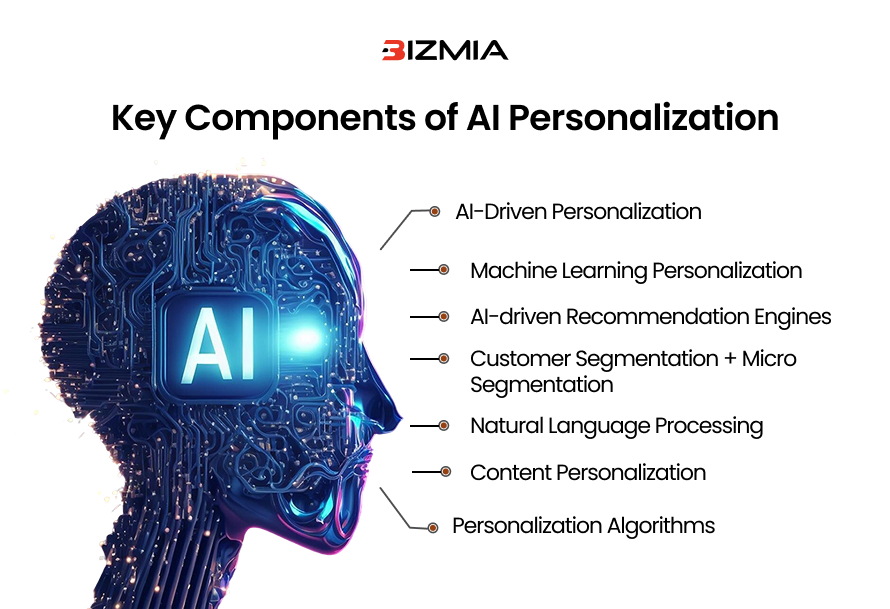
1. Data-Driven Personalization
Data is the cornerstone of personalization. The more comprehensive and accurate the data, the better the outcomes of personalization. The following are the types of data that are relevant:
- Behavioral Data: browsing history, clicks, and time on page
- Demographic Data: gender, age, location
- Transactional Data: Average order value, past purchases
- Contextual Data: Time of day, traffic source, device used
By utilizing these datasets, Shopify store owners can design a 360-degree view of the user and customize experiences accordingly. Also,
2. Machine Learning Personalization
Machine learning personalization allows systems to learn from customer experiences continuously. Let’s see some examples for better understanding:
- If a customer ignores promotional emails but usually responds to in-app offers, ML adapts to it by prioritizing in-app notifications.
- If shoppers tend to place orders for bundle products, at checkout, ML recommends smart product bundles.
- In contrast with rule-based personalization, ML is getting smarter over time, making sure suggestions remain relevant.
3. AI-driven Recommendation Engines
One of the most visible forms of AI personalization is recommendation engines. They are behind features like:
- Frequently Bought Together’ recommendations.
- Customized product recommendations on product pages and homepage
- Upselling and cross-selling during checkout
Apps like Nosto, LimeSpot, and Clerk.io offer recommendation engine capabilities, assisting stores in reducing cart abandonment and boosting AOV.
4. Customer Segmentation + Micro Segmentation
Usually, traditional segmentation groups of clients by demographics. However, AI segmentation uses advanced techniques based on real behavior to create micro-segments.
Let’s have an example:
- Segment A: Shoppers who are budget-conscious and abandon carts more often
- Segment B: Premium and loyal buyers who respond to early-access offers
Shopify merchants can target campaigns with surgical precision through these segments.
5. Natural Language Processing (NLP)
AI chatbots and voice assistants are powered by NLP. It enables machines to understand human intent, language, and tone.
NLP is used in Shopify stores for:
- Instant chatbot support and product recommendations
- Processing customer reviews to detect trends
- Activating voice-enabled shopping.
6. Content Personalization
With AI personalization, your site content doesn’t stay static. Instead, AI adapts in real-time:
- Based on browsing history, your homepage banners have changed.
- By analyzing user behavior, pop-ups deliver exclusive discounts.
- For each recipient, email campaigns adjust offers and subject lines.
7. Personalization Algorithms
Different personalization algorithms fuel different outcomes:
- With collaborative filtering, AI suggests products based on the purchase history of a customer.
- Through content-based filtering, products having similar attributes (size, style, and color) are recommended.
- With hybrid models, both approaches are combined with accuracy.
Why These Components Matter
Every AI personalization component works together as gears in a machine. For Shopify merchants:
- They deliver an experience that feels human and unique.
- Scale personalization for thousands of customers at once
- Build loyalty via continuous adaptation and learning.
Top 6 Benefits of AI Personalization for Shopify Stores
As a whole, AI personalization is not just another innovation; it’s a competitive essential. In the competitive e-commerce markets, Shopify merchants who opt for AI personalization are getting bigger basket sizes, higher conversions, and improved customer loyalty in comparison with those who stick to generic personalization strategies.
Let’s dive into the top benefits of AI personalization for Shopify stores:

1. Enhanced Conversions
If shopping experiences are relevant, customers are more likely to buy their favorite products. AI makes sure that every touchpoint is customized as per the clients’ expectations. It includes everything starting from the homepage banner to checkout page customizations.
Key Stats: McKinsey states AI personalization can boost conversation rates up to 30%.
Example: A clothing brand on Shopify can benefit from AI personalization and display “Frequently Bought Together” bundles, instead of selling single clothing items-improving sales.
2. Higher Average Order Value (AOV)
Artificial Intelligence personalization doesn’t just convert potential shoppers into buyers; it upsells and cross-sells intelligently. AI assists Shopify stores in increasing average order value (AOV) by suggesting premium upgrades, personalized bundles, or complementary products.
Example: A cosmetics brand added AI personalization in a Shopify store to suggest a skincare set when a user adds moisturizer in their cart to shop. Customers spend more and perceive it as a value bundle.
3. Better Customer Retention & Loyalty
Usually, retention matters more than acquisition in terms of online shopping. By providing consistent and memorable shopping experiences, AI personalization keeps customers coming back. It gives:
- Customized offers based on past shopping experience
- For loyal shoppers, early access to new products
- Discounts and rewards that match the user’s shopping behavior
Key Stats: As per Epsilon’s stats around 80% of customers are likely to become repeat shoppers when they are offered customized experiences.
4. Reduced Cart Abandonment
In e-commerce, cart abandonment is one of the biggest challenges for store owners. AI in e-commerce or AI personalization, particularly in Shopify, helps reduce the cart abandonment rate through:
- Personalized email reminders along with incentives
- Giving dynamic discounts to buyers who are usually hesitant to shop
- Complementary products make checkout complete.
5. Improved Customer Insights
Beyond transactions, AI gives deep insights into customer behavior. These insights can be used by Shopify merchants to:
- Target high-value customer segments
- Optimize store inventory management on predictive demand.
- Personalize marketing teams for different micro-groups
As a result, it not only ensures higher sales today but also long-term business growth.
6. Better Shopping Experience
When buyers feel understood and recognized, they are more likely to purchase, engage, and advocate for the brand. A smooth shopping experience is ensured:
- Through AI-powered chatbots giving human-like support
- Customized homepage layout based on users’ browsing history
- Dynamic search results customized to customers’ preferences
Why It’s Important for Shopify Retailers
It’s beneficial for Shopify merchants to deploy AI personalization because it is directly linked to revenue growth. It shapes a win-win situation:
- Shoppers get an enjoyable and seamless shopping experience.
- Merchants gain repeat purchases, higher sales, and long-term loyalty.
In 2025, failing to personalize your Shopify store means losing your clients to those who do.
Practical Ways AI Personalization Improves Shopify Stores’ Sales
Personalization through AI is no longer a futuristic idea-it’s actively modifying how Shopify merchants operate today. By combining AI personalization with the Shopify store ecosystem, retailers are offering highly tailored experiences that drive higher sales and measurable results.
Let’s see how AI personalization is practically transforming Shopify stores:
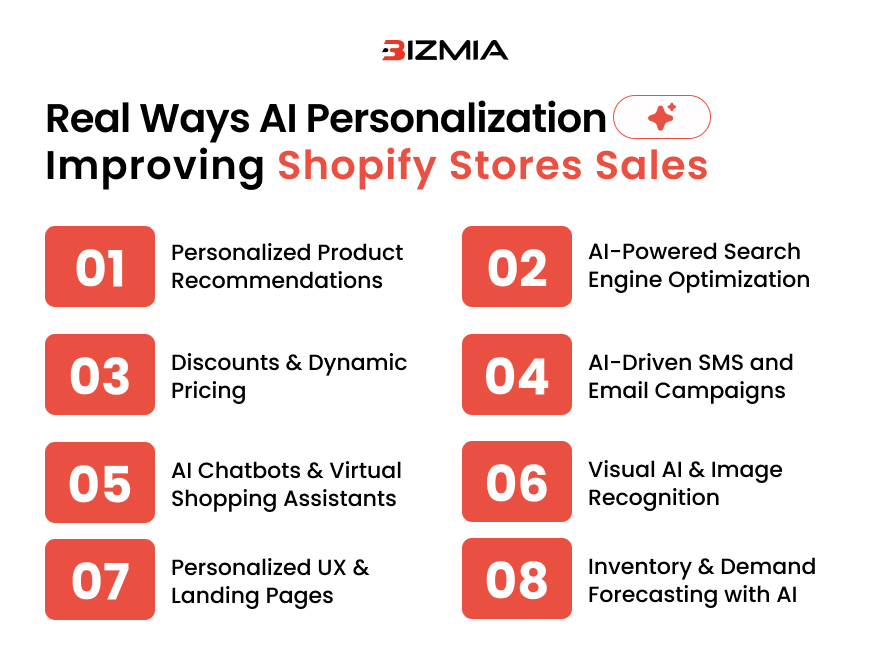
1. Personalized Recommendations of Products
AI tracks past purchases, browsing history, and dwell time on a specific product to suggest items that are most likely to convert.
- Example: If a customer purchases a yoga mat, AI can recommend resistance bands, yoga blocks, or fitness wear.
- Tools powered by AI like Recom.ai and LimeSpot, integrate easily with Shopify to offer personalized recommendations.
How it impacts Shopify stores: Around 31% of e-commerce revenues are driven by personalized recommendations.
2. AI-Powered SEO
Generic search bars depend on keywords, but AI-powered search understands context and intent.
- For example, a customer typing “red summer dress” also sees results for “crimson beachwear” or “burgundy floral sundress”.
- Certain tools like Algolia and Searchspring use machine learning personalization to provide predictive and smarter search results.
How it impacts Shopify stores: AI-powered search results lead to 3- 5x higher conversion rates in comparison with basic keyword search.
3. Discounts & Dynamic Pricing
To offer discounts and set optimal prices, AI uses competitors’ analysis, customer behavior, and real-time market data.
- For instance, a first-time visitor or shopper may get a 10% discount to boost conversion.
- Based on purchase frequency, loyal customers may receive customized offers.
How it impacts Shopify stores: Dynamic pricing driven by AI can enhance profits by up to 25% while keeping shoppers satisfied.
4. AI-Driven SMS/Email Campaigns
Traditional marketing emails are no longer useful. Data-driven personalization enables Shopify store owners to send:
- Cart abandonment reminders and tailored incentives
- Product suggestions based on browsing history
- Customized birthday or anniversary discounts
How it impacts the Shopify store: 6x higher transaction rates can be generated through personalized AI email campaigns.
5. AI Chatbots
These chatbots do a lot more than answering usual queries. These chatbots act as personal shopping assistants for every customer:
- They track orders, recommend products, and even upsell in real-time.
- Apps on Shopify like Heyday by Hootsuite and Tidio use conversational AI to offer interactive shopping experiences.
How it impacts Shopify stores: AI chatbots can take care of 80% of customer inquiries, reducing costs, saving time, and improving sales.
6. Visual AI & Image Recognition
When customers upload images, AI can analyze those images and recommend complementary or matching products.
- Example: a shopper uploading a picture of a handbag for reference, and AI is suggesting similar styles or colors available in the store.
- AI tools such as ViSenze offer visual AI search solutions for e-brands
How it impacts the Shopify store: Visual search improves discovery rates by up to 20%.
7. Customized UX & Landing Pages
Instead of displaying the same homepage to everyone, AI designs dynamic landing pages personalized to user profiles:
- A returning client may see suggestions based on their past purchases.
- New buyers may get discounted or trending items to encourage them to buy something from a particular store.
How it impacts the Shopify store: Customized landing pages can boost engagement by 50%.
8. Inventory & Demand Prediction
AI doesn’t just customize the front-end but also takes care of backend operations. It includes predicting which products are going to sell out more and suggesting restocking schedules based on customer behavior and seasonal demand.
How it impacts the Shopify store: Stockouts are reduced by up to 65% by ML personalization in inventory.
Challenges You Might Face in Implementing AI Personalization
Here we are jotting down some common challenges that you might come across while implementing AI personalization to your Shopify store:
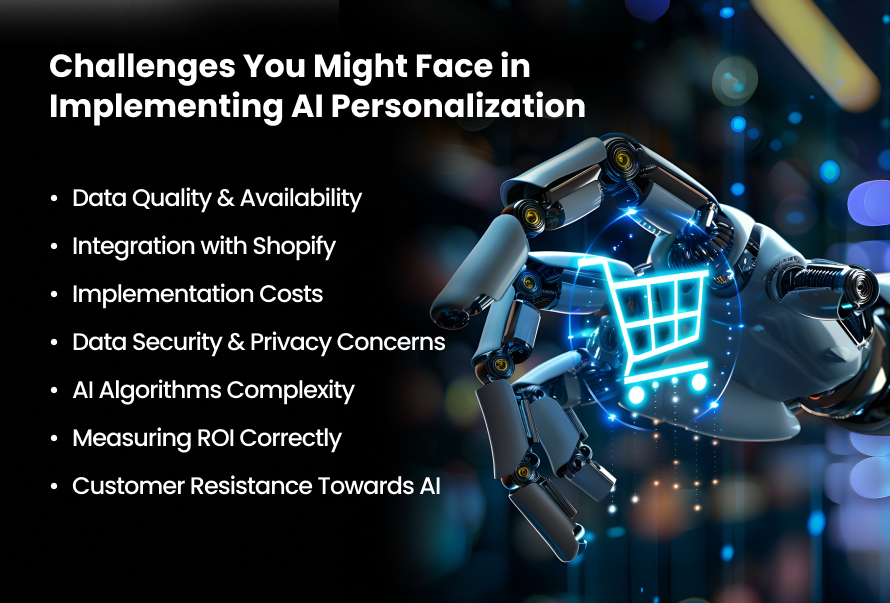
1. Data Quality & Availability
AI is completely dependent on data. Without structured, consistent, and clean datasets, personalization won’t work the way it should. I may lead to duplicate records, fragmented customer profiles, and incomplete purchase histories.
2. Integration with Shopify
Although Shopify backs multiple AI-powered apps, smooth integrations with CRMs, analytics platforms, and third-party tools can be tricky. This may result in merchants facing conflicts between plugins or compatibility issues.
3. Implementation Costs
Usually, basic AI tools are not very expensive, but advanced ML personalization platforms need significant investments. Smaller retailers may suffer to justify the high subscription costs that can range from $200 to $2000 per month.
4. Data Security & Privacy Concerns
Personalization relies on data collection and analysis. However, users are more privacy-conscious than ever. Compliance with Shopify’s data policy, CCPA, and GDPR is a challenge.
5. AI Algorithms Complexity
It can be overwhelming to understand and configure AI models for non-technical users. Misconfigured AI may lead to irrelevant product recommendations.
6. Measuring ROI Correctly
In contrast with paid ads, where ROI is straightforward, evaluating the impact of AI personalization is difficult. Without clear tracking mechanisms, merchants risk overestimating or underestimating AI’s potential.
7. Customer Resistance Towards AI
Not all shoppers embrace AI. They prefer traditional online shopping. They may get frustrated by a chatbot when they want to connect and inquire from a real person.
How to Implement AI Personalization in Your Shopify Store?
By now, you are well aware of what AI personalization is, its key components, benefits for Shopify stores, practical ways of improving sales, and what issues you may deal with. So, let’s learn step-by-step how you can implement AI personalization in your Shopify store:
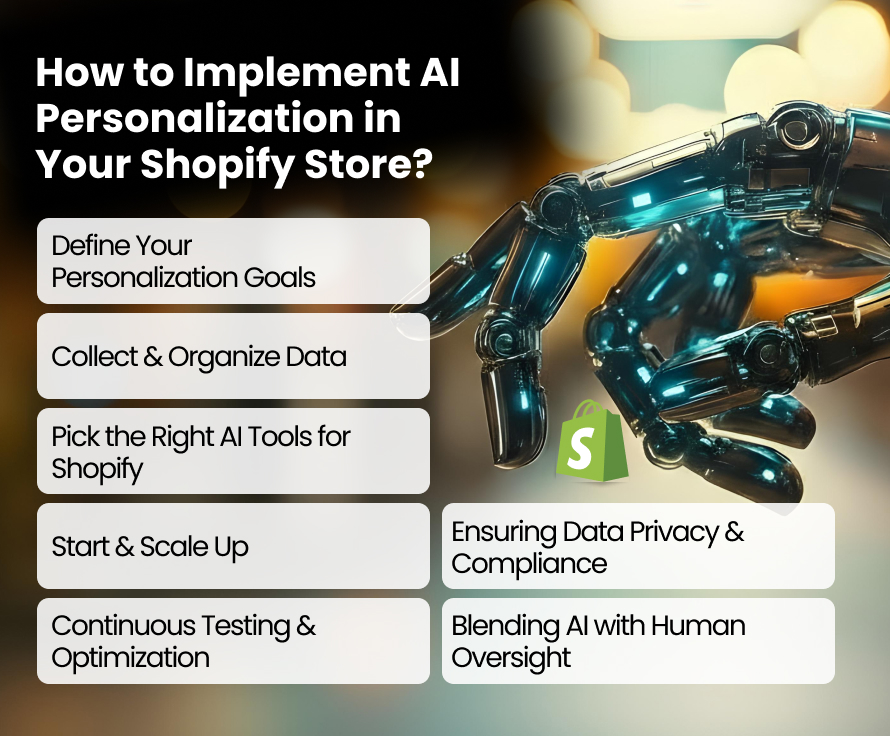
1. Define Your Personalization Goals
Always start by defining your brand goals and why you want to opt for personalization. You can make a list if you want to increase conversions with product recommendations, reduce cart abandonment with personalized reminders, or improve AOV with bundling or upselling.
2. Collect & Organize Data
If the data provided to AI is good, it gets better with it. You can integrate Shopify Analytics, Google Analytics, email platforms, and CRM. Segment the data into purchase history, engagement patterns, browsing behavior, and demographics.
3. Pick the Right AI Tools for Shopify
Out of Shopify’s huge collection of AI personalization tools, pick the tools that are best suited for your requirements:
| Task | AI Tool |
|---|---|
| Product Recommendations | Recom.ai, LimeSpot, Wiser |
| Search & Navigation | Algolia, Searchspring |
| AI Chatbots & Voice Assistants | Octane AI, Tidio, Heyday |
| SMS/Email Personalization | Klavio, Privy |
| Dynamic Pricing | BlackCurve, Prisync |
4. Start & Scale Up
Always start simple and don’t overwhelm your store with various and advanced AI features at once; take things gradually. Start with one essential feature, give time, monitor results, and then roll out additional personalization features.
5. Continuous Testing & Optimization
Implementing AI personalization is not a “set it and forget it” thing. You should run A/B tests on standard layouts vs AI recommendations. Also monitor KPIs like AOV, CTR, cart abandonment recovery, and bounce rate.
6. Ensuring Data Privacy & Compliance
Users mostly value personalization, but they fear misuse of data. So, always be transparent about what data you collect from them and how you use it. Also, comply with Shopify privacy policies, CCPA, and GDPR.
7. Blending AI with Human Oversight
Although AI is strong, human intuition always matters. You can ensure relevance by reviewing AI product recommendations from a consumer point of view. Also, balance automation with human touches.
How To Measure The Impacts of AI Agents?
You can use these key metrics to assess the impacts of AI agents on Shopify store sales or overall brand:

- Key Metrics to Track: Conversion rate, AOV, cart abandonment rate, CLV, Repeat Purchase rate, CTR
- Attribution Models: First touch attribution, Last touch attribution, middle touch attribution
- AI Vs Non-AI-A/B Testing: Split testing, compare versions, AOV, bounce rate, run tests long enough to achieve statistically significant results.
- Monitoring AI-Powered Customer Journeys: Shopify Analytics, Google Analytics 4, CRM dashboards
- Marketing ROI Measurement: Open rates, CTR, ROAS, Customer engagement
- Customer Feedback & Sentiment Analysis: Also consider customer sentiments beyond numbers as well
- Long-term Influence-CLV & Retention: Track Customer Lifetime Value, retention rates, subscription renewal rates
Future of AI Personalization + Shopify Stores
We can foresee that the future of AI personalization in Shopify is not just limited to better product recommendations; it’s more about reimagining the complete Shopify journey. It may include:
- Hyper-personalized shopping experiences
- Virtual shopping assistants powered by AI
- Predictive and productive commerce
- AI-driven content creation for Shopify stores
- AR, VR, and deeper AI Integrations
- AI and voice commerce
- Transparent and ethical personalization
Final Thoughts
AI personalization is not just a fancy thing to have in your Shopify store. It’s the major driving engine behind your brand success in 2025. It is truly transforming Shopify stores into sales machines for merchants by providing experiences that feel human-like, relevant, and unique. With AI personalization, Shopify stores are now understanding their customers better through personalized product recommendations, dynamic pricing, chatbots, and AI-driven email campaigns.
Yes, there are some challenges, but if implemented well, AI personalization is going to fuel your future growth just like the present.