

Shopify vs Magento 2 Customization
Customization is the number one priority for SMBs as well as enterprises. The level of customization is essential so that in future a business can expand their features and functionalities easily.
They both offer very different experiences but there are some limitations to each of them. Shopify provides a user-friendly interface and also has a wide range of pre-built themes and apps that users can take advantage of to customize their stores without requiring any technical expertise.
But there are limitations in Shopify as users do have the option for advanced customizations due to its controlled ecosystem.
On the other hand, Magento offers unlimited customized for the users even at enterprise level. The users on Magento can customize both the front end and backend that enables business to create a highly tailored eCommerce experience.
So, if we have to conclude for Shopify vs Magento customization, then Magento offers much more customization than Shopify.
Magento Vs Shopify Integrations
Shopify and Magento both offer several integrations so that users can enhance their store features and functionalities and provide a seamless user experience.
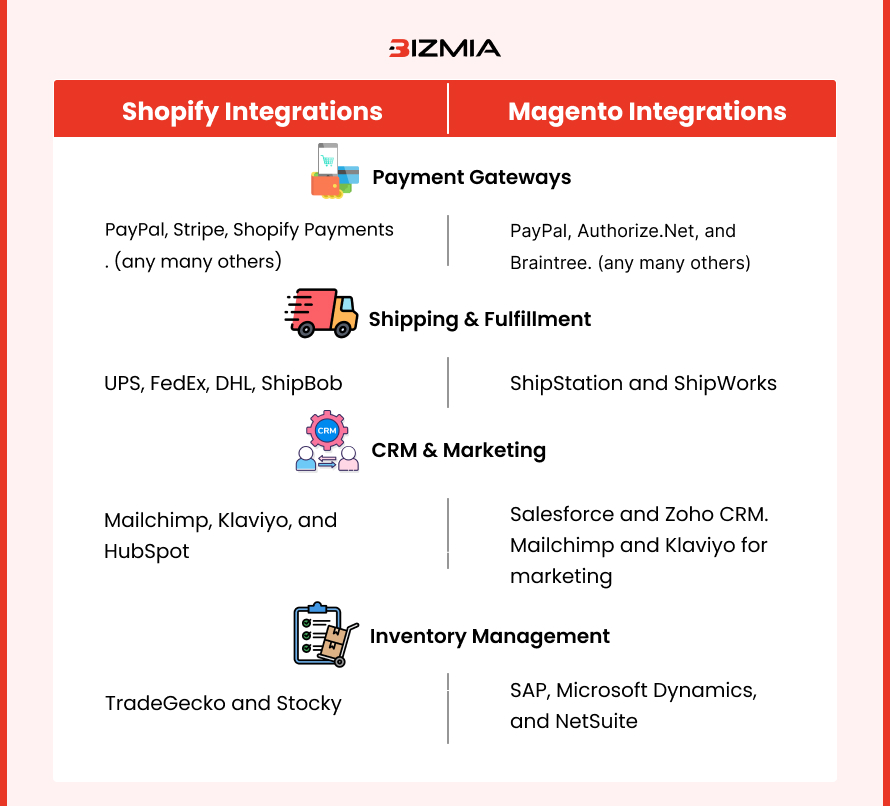
Start with Shopify first. It offers a wide range of pre-built integrations that merchants can use and connect with their stores. These integrations cover areas like payment gateways, marketing tools, shipping services, and inventory management. Moreover, another advantage for the users is that Shopify’s App Store contains thousands of apps that enable easy plug-and-play integrations.
So, for example, there are over 100 payment gateways, for instance PayPal, Stripe, and its own as well i.e., Shopify Payments. In addition to that, it has native integrations with carriers like UPS, DHL, and FedEx for automating the processes. You can also utilize the CRM and Marketing integrations like MailChimp, etc., to optimize your store for marketing strategy and conversions.
In Magento, there is far more flexibility than Shopify for third-party integrations. However, adding third-party integrations in an open-source e-commerce platform i.e., Magento requires technical and web development expertise. You can hire Magento 2 developers to get robust third-party integrations seamlessly and enhance store’s functionalities.
Speaking of payment gateways, Magento has a variety of payment options, including PayPal, Authorize. Net, and Braintree. If a merchant wants more customization, then developers can also build custom payment gateways tailored to a business’s specific needs. For instance, a custom gateway for cryptocurrency payments can be added using Magento’s open-source features.
You can also integrate your Magento store with third-party CRMS and marketing software such as Salesforce and Zoho CRM, Klaviyo, and MailChimp.
Shopify or Magento: Apps and Addons
Shopify and Magento have a wide range of apps and add-ons, plugins and third-party applications for enhancing features and functionality to your store.
Shopify has a gated app store in which technology app partners appear. You will find a huge range apps that can significantly improve your on-site features, loyalty schemes, sales features, accountancy, email marketing, reviews, and more.
The total count of Shopify apps is around 8000 and more are coming. If you want to get custom apps developed, you can do it easily in Shopify.
Speaking of Magento, it has a similar app for applications, plugins, and addons that is known by the name of Adobe Commerce Extension Marketplace. It has over 4k extensions that can be used to enhance the functionality of your Magento store. However, to build custom apps, you will need technical developer assistance.
Shopify vs Magento: AI Tools
Both eCommerce platforms Shopify and Magento offer various AI tools that provide great help in enhancing your store features and functionalities. The top Shopify AI tools include ChatGPT, ClickUp, Bazar Voice, and similar tools.
For Magento, standout AI tools include the ChatGPT AI Content Generator for Magento 2 and the ChatGPT SEO Optimizer AI, among others.
Compare Magento and Shopify: Content Management Systems
When comparing Shopify vs Magento, there is a wide difference between both of them based on flexibility, ease of use, requirement of technical assistance, and features.
Shopify offers a user-friendly CMS with drag-and-drop feature that makes it easier to use for the beginners as well as intermediate and experienced users. For tips on getting the most out of Shopify’s CMS, check out our guide on Shopify success secrets and practices for eCommerce development.
In addition to that, Shopify includes built-in blogging, product management, and SEO tools, making it a great all-in-one platform for straightforward content management.
If we talk about customizations, Shopify comes with limitations. There is just enough number of customizations you can do as compared to Magento.
On the other hand, Magento is highly flexible and provides great control over the content layout and design but requires technical knowledge or developer support to maximize its potential.
It offers widgets as well such as custom content blocks, dynamic widgets, and third-party integrations. So, if you want a robust content management system that offers customizations and can help you expand it as per your requirements then Magento is the winner. But if you want a pre-built content management system and you do not require to bring a high number of modifications to it, then Shopify would be the best choice to make.
Shopify vs Magento: Development and Coding
Shopify is a fully-hosted platform which means that you don’t need to worry about server setup, maintenance, or technical configurations. You can say Shopify is a low-code platform where you only need to work on coding when bringing customizations to your eCommerce store. You might need to leverage Shopify development services to bring customized features and enhance the customer experience.
Magento requires technical assistance, coding, and development to bring the customizations to your store. Even though its open-source version is free, and self-hosted but for customizing your eCommerce store, it needs technical expertise and resources for setup, development, and maintenance.
You should choose Shopify if you need simplicity and easy setup. However, if you want to go on to an advanced level of customization, then Magento would be the right choice.
Difference Between Magento and Shopify Payment Gateways
Shopify supports over 100 payment gateways, including popular options like PayPal, Stripe, and Authorize.Net. It also has its own payment processor, Shopify Payments, which eliminates transaction fees (except credit card fees) and simplifies the setup process. However, using third-party payment gateways may incur additional transaction fees, which can be a drawback for some businesses.
Magento offers even greater flexibility, supporting nearly any payment gateway you choose. With its open-source nature, you can integrate custom payment solutions tailored to your business needs. Unlike Shopify, Magento doesn’t impose transaction fees, but you’ll need technical expertise to configure and manage some gateways.
However, you must consider a few factors such as ease of setup (only in Shopify), transaction fee (Shopify charges, Magento does not), and custom payment options (Magento is ideal; Shopify offers less customization options).
We can say that Shopify offers convenience with its native payment solution and straightforward integration. Magento, on the other hand, provides unmatched flexibility for businesses with complex payment requirements.
Shopify Vs Magento: SEO Capabilities
A solid SEO foundation is available with Shopify. That’s the reason it offers responsive and clean store themes, faster page loading speed, blogging functionality available by default, and basic level control over URLs and meta tags. This makes Shopify the ideal fit for brands looking for effective and simple SEO.
But there are also some limitations associated with Shopify, including limited control over SEO elements, dependency on applications, and restricted URL structure.
E-commerce brands looking for full-scale SEO flexibility; Magento has them covered. It offers advanced schema customization and meta data, has powerful internal linking abilities, and effectively manages large product catalogs. It’s the perfect platform for brands, eying long-term growth and competitive keywords.
Speed and Performance: Shopify or Magento, Which One is Faster
Shopify takes care of performance optimization through minimal setup required, optimized hosting, and built-in CDN. This results in reliable and consistent speed, avoiding technical difficulties.
The performance of Magento depends on its configuration, which requires optimization and caching. If properly optimized, it can outperform Shopify. Also, hosting quality is important.
Security Compliance: Magento Vs Shopify, which is Safer
Shopify platform updates automatically; it is a fully PCI-DSS complaint platform and has built-in SSL certificates. That’s why there’s no need for manual security.
Magento is a highly secure eCommerce platform. It also requires monitoring and manual updates, making it suitable for teams with tech support.
Magento vs Shopify: Key Feature Comparison Main Table
Consider the table to compare Magento vs Shopify on a major level:
Key Features | Magento | Shopify |
1.Platform Type | Open-source Highly flexible | Closed All-in-one platform |
2.Hosting | Self-hosted (Cloud option available) | Fully hosted |
3.Bandwidth | Depends on hosting | Unlimited |
4.Multi-Store | Supported | Not built-in |
5.Customization | Full control | Limited User-friendly |
6.SEO | Advanced level control | Strong basics |
7.Mobile Optimization | ✔️ | ✔️ |
8.Integrations | Flexible | Easy via apps |
9.Payments | No native gateway | Shopify Payments and others |
10.Inventory and Orders | Advanced | Built-in and simple |
11.Cart Recovery | Available | Built-in |
12.Analytics | Advanced | Built-in |
13.Multi-Currency/Lang | ✔️ | ✔️ |
14.URL Control | Full control | Limited |
15.B2B Features | Strong | Limited |
16.Scalability | Enterprise-level | High |
17.Marketing Tools | Flexible | Built-in + apps |
18.App Marketplace | Large | Large |
19.SSL and Security | Manual setup | Included |
20.Compliance | Depends on setup | Built-in |
21.Maintenance | Ongoing effort | Minimal |
Who Should Choose Magento vs Shopify?
You can sign up for Shopify if you are planning to launch your store quickly, avoid complexities, or seek a fully managed and well-structured platform. You can also opt for Shopify for running a DTC brand, with predictable monthly costs and a small to medium-sized product catalog.
Magento is suitable for you if you need unique workflows or custom features. To operate B2B or hybrid B2B and B2C models, scale in the future, and handle multiple stores or product catalogs.
Shopify Vs Magento: Some Real-World Use Cases
Some popular use cases of Shopify include the first online store of startups, a fashion brand emphasizing marketing, social commerce, or branding. Shopify is also used by drop shipping businesses for automation and integration.
Common use cases of Magento include a large retailer handling SKUs, a brand requiring custom integrations, and a B2B business seeking account-based buying, bulk order, and custom pricing.
Conclusion
Shopify and Magento are both the top e-commerce platforms. Shopify is an ideal choice for beginners and SMBs whereas Magento is an ideal platform for enterprises and those businesses who in growing exponentially and want to expand their business operations. With Shopify you can get an easy setup with many amazing features, and Magento provides greater flexibility and scalability.