

Top Recommendations for Retailers
For a better generative AI, SEO retailers should:
- Provide their product descriptions in a conversational and natural tone.
- Keep holiday shopping e-commerce trends and holiday-specific questions in mind, such as trending gifts, affordability, and last-minute delivery.
- Insert Q&A section to category pages and products.
- Work on using structured data so that AI can assess whether your content is the best match or can be recommended for queries.
Takeaway: Holiday SEO is not just about ranking against specific keywords-it’s more about being the best answer to holiday shoppers’ queries.
Why Fresh Feed & Structured Data are Non-Negotiable
For AI search SEO, fresh feed and structured data are not just ‘nice-to-have’ anymore. They are the foundation of holiday SEO in 2025. If you don’t focus on these things, your products might be invisible to AI engines like ChatGPT Search, Google SGE, and retail markets like Amazon.
Why Fresh Feed Matters?
Fresh feed is important because holiday shopping is time sensitive. AI engines show products as recommendations that are:
- With accurate pricing
- In stock
- Available for shipping during the holiday season
AI removes your products in favor of competitors who update their data regularly, so keep your inventory feed updated. For example, if your site says a laptop is available, but it’s out of stock, AI learns that your data is not trustworthy.
What is Structured Data?
The code that assists AI and search engines in understanding your product description or other content better, is called structured data. You can understand this as a translator where humans see it as “$89 shirt with free shipping”, AI engines read structured products as:
- Name: Men’s Winter Shirt
- Price: $89
- Availability: In stock
- Shipping: Before Dec 27
- Reviews: 4.5/5 (170 reviews)
This approach enables AI to pick your products and give them as recommendations in holiday shopping queries.
Here are some useful structured data elements:
| Schema Type | Purpose | Example |
|---|---|---|
| Product | Helps AI understand item name, price, stock, and description | Winter Boots, $99, In Stock |
| Offer | Defines promotions or discounts | “15% off Black Friday Sale” |
| Review | Improves credibility in AI results | Average rating: 4.8 from 320 reviews |
| FAQPage | Helps appear in voice and AI summaries | “What is your shipping cutoff date?” |
| BreadcrumbList | Clarifies page hierarchy for AI | Home > Shoes > Men’s Sneakers |
| ShippingDetails | Adds delivery timelines | “Ships before Dec 24” |
How It Affects Holiday SEO
Fresh feeds and structured data directly influence Generative Engine Optimization and Answer Engine Optimization:
- Impact on AEO: With schema markup, AI can better understand and show your product info as the “best answer” for queries.
- Impact on GEO: With the help of updated feeds, products easily appear in generative shopping recommendations.
An Action Plan for Retailers
Here’s the plan a retailer can adopt for better results:
- Implementing product schema markup: While implementing the product schema markup, don’t forget to include name, price, description, shipping, availability, reviews, and promotions.
- Utilizing Real-time Inventory Feeds: You can modify your e-commerce platform or CMS with AI search engines and marketplaces. Professional e-commerce web developers can take care of these things and help boost sales. Also, ensure that your updates reflect discounts, delivery timeline, and stock levels.
- Highlighting holiday deadlines: You can add schema for shipping cut-off dates like for Black Friday vs Cyber Monday sales, to help AI engines to display key delivery information.
- Keeping Data Consistent Across marketplaces: Sync your product data across multiple marketplaces like Amazon, eBay. Google Shopping and Walmart.

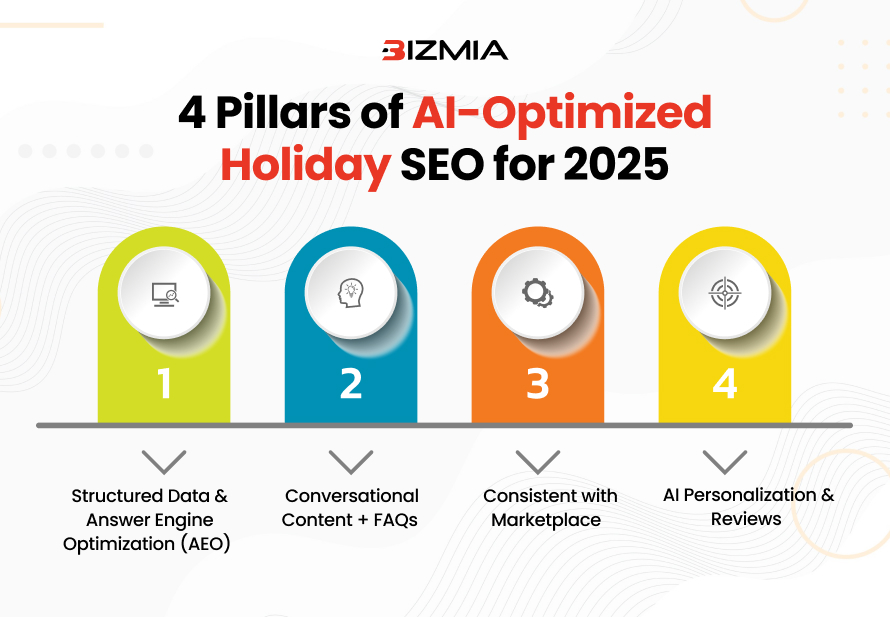
4 Pillars of AI-Optimized Holiday SEO for 2025
Retailers should rethink everything from product content to data, reviews, personalization, and others to boost their holiday SEO this year. AI is no longer about ranking your site; it’s about selecting the answers.
We are giving 4 pillars that every merchant should master to succeed in holiday e-commerce SEO in 2025:
1st Pillar-Structured Data & Answer Engine Optimization (AEO)
AEO is all about making your content ‘the answer’ when shoppers ask a holiday-related question. AI engines need precise and structured content, not vague answers. Retailers can implement schema markup, shipping time, discounts, and product details. They can also anticipate holiday season-specific queries that shoppers ask and can answer them on their website.
Example: If your structured data matches the question a description “best stuffed toy for 2-year-olds under $40 for Christmas 2025,” it should lead AI directly to your page.
2nd Pillar-Conversational Content + FAQs
This is important because people now use conversational and natural language to search for their desired products. The content written in such a style makes FAQ-driven content a goldmine for holiday SEO. AI engines respond best to it. To ensure this, retailers can create holiday-specific content hubs, insert Q&A sections on their product pages, and incorporate holiday shopping trends into their blog posts.
Example: A blog with the title: “Top 10 eco-friendly gifts for holiday 2025” will not only attract traffic but also provide AI engines with the content that is required.
3rd Pillar-Consistent with Marketplace
Market consistency is essential because AI search engines not just crawl your website, but they also cross-check everything with marketplaces like Amazon, Google Shopping, eBay, and Walmart.
Brand owners can strategize their consistency with the marketplace by writing clear and concise product descriptions, consistent pricing, and availability across all channels. Also, by paying attention to holiday promotions, if a product is for $68 and on Amazon is $78, AI may not recommend your product in search results.
Example: If a shopper inquires: “Where can I buy a Coach bag with shipping under $350?”. AI may not recommend your products if your listings are not aligned across platforms.
4th Pillar-AI Personalization & Reviews
AI is all about personalization and reviews. Products having authentic and frequent reviews will be prioritized. Personalized product recommendations also keep shoppers engaged during the busy holiday season.
Merchants can encourage customers to leave reviews in text, images, or video form, highlight reviews in schema markup, or they can show case holiday urgency in product pages and reviews.
All 4 Pillars Working Together
If we see every pillar individually, each one strengthens your SEO game. However, together they work as a holiday SEO strategy, which is effective for AI:
- Pillar 1-structured data: Speaks AI language
- Pillar 2-conversational content: It matches shoppers’ questions
- Pillar 3-marketplace consistency: AI trust building
- Pillar 4-personalization+reviews: helps in converting shoppers into buyers
Brand owners who master these pillars will dominate holiday search SEO and capture a significant place in the 2025 holiday e-commerce market.
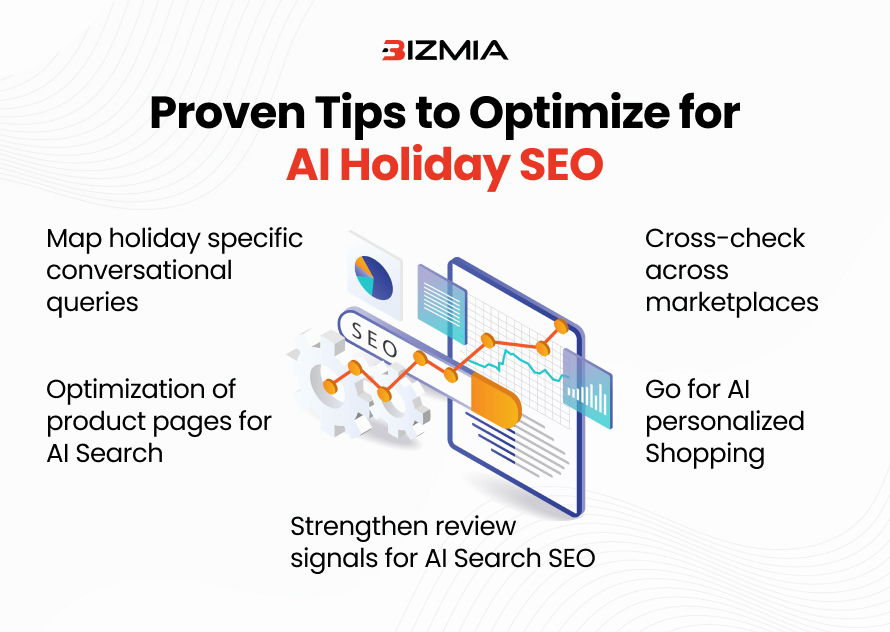
Proven Tips to Optimize for AI Holiday SEO
After discussing the basics of AI in e-commerce and the four SEO pillars, let’s get practical. These are some of the best tips for retailers to win the holiday SEO race in 2025 and improve visibility during the biggest shopping season of the year:
1. Map holiday-specific conversational queries
Rather than relying on generic keywords, focus on holiday-specific queries natural and conversational in tone. For this purpose, you can use tools like SEMrush, AnswerThePublic, and People Also Ask to find natural language and long-tail queries. You can also create holiday-specific FAQ pages to answer questions directly.
Example: “What are the best last-minute Christmas gifts for children under the age of 7?”
It would be a good idea to include such questions in product descriptions, FAQs, and blog posts.
2. Optimization of product pages for AI Search
Data in AI search engines is pulled directly from product pages, so make sure that your content is AI-friendly. You can do it by adding schema markup for product details, writing natural and conversational product descriptions, and including holiday specific FAQs.
Example: A product page for running shoes should include:
Description: “The best shoes for fitness enthusiasts this Christmas”
FAQ: “Are these running shoes suitable for the gym?”
Schema: “In stock availability, delivery before Christmas”
3. Strengthen review signals for AI Search SEO
For AI search SEO, reviews are one of the strongest trust signals, and they can make or break your sales during the peak holiday season. You can maintain good reviews by encouraging buyers to leave reviews, highlighting holiday season-specific reviews, using schema to markup review snippets and ratings, and prioritizing recent reviews.
4. Cross-check across marketplaces
Your consistency is cross-checked across multiple marketplaces by AI engines. Your credibility may drop if your product descriptions, pricing, or availability don’t match. You can maintain consistency by syncing product data across marketplaces like eBay, Amazon, Google Shopping, and Walmart.
Retailers can also use feed management tools like GoDataFeed or DataFeedWatch, or they can double-check discounts and promotions to stay consistent.
5.Go for AI personalized Shopping
Retailers who create personalized shopping experiences are favored by AI search-because such experience matters for shoppers. You can ensure it via AI-powered recommendation engines (Magento plugins, Shopify apps,etc), by offering gift finders, and creating personalized bundles.
Why are these tips useful?
These AI-based SEO optimization tips are essential for:
- Improved visibility in AI-based shopping searches
- Boost conversion rates
- Stronger brand image
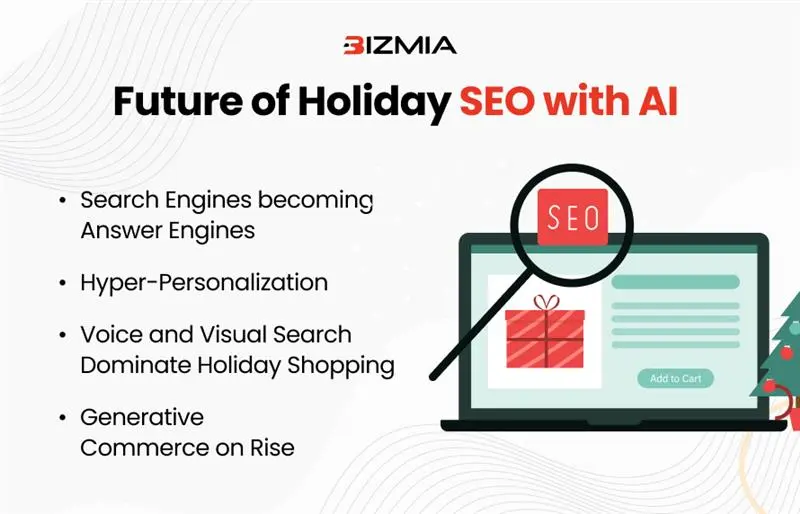
Future of Holiday SEO with AI
This 2025 holiday season is just the beginning. AI search is not a temporary thing; the future of online discovery and shopping lies in it. Retailers who master these strategies will be way ahead when more advanced generative AI SEO tools are launched.
1. Search Engines becoming Answer Engines
By 2026 and beyond, the line differentiating AI assistants and search engines will most likely vanish. As a result, shoppers will receive context-based personalized answers rather than browsing through 10 different results.
AI will give direct shopping recommendations based on queries, making feed accuracy, trust signals, and structured data more accurate.
2. Generative Commerce on the Rise
Generative AI will create even more personalized shopping experiences for shoppers, and you never know, AI assistants may be giving multiple facilities soon, like:
- Generating personalized gift guides
- Adding products from multiple retailers into one order
- Suggesting options for decor, holiday outfits, and gift baskets based on liking
3. Hyper-Personalization
It may be possible to give ultra-specific product recommendations based on browsing patterns, purchase history, local inventory, and social media behavior. That’s why retailers must invest in AI personalization engines going beyond “customers also bought”.
4. Voice and Visual Search Dominate Holiday Shopping
The merger of AI with voice assistants (Siri, Alexa, Google Assistants) and visual search tools (Google Lens, Pinterest Lens) is urging retailers to optimize for multimodal AI search.
Wrapping Up
The holiday shopping season, especially in the USA and around the globe, has always been a high-stakes competition for brands to sell. In 2025 and beyond, retailers who understand and implement AI search SEO will be the winners. Keyword stuffing and meta titles tweaking are not helping much now because search has become more contextual, conversational, personalized, and experience driven.
So, retailers who master generative AI SEO, Answer Engine Optimization, and holiday shopping trends will not only attract customers in 2025 but also will future proof their brands’ e-commerce growth.