

E-Commerce brands face new challenges as they expand, including complex operations, high traffic volume, and large-scale competition. That’s why it has become more essential than ever to migrate to Shopify Plus in 2025. You don’t need the basic plans, as customer preferences have changed, and the better you offer to your customers, the better your business grows.
Shopify Plus migration comes with several benefits, including customization, headless commerce, reduced transaction fees, multi-store expansion, and you surely don’t want to miss those. If you are confused about when to migrate from your existing platform, now is the ideal time. Beyond the limitations of standard Shopify, the Plus version is designed for brands looking to scale up their growth.
In today’s blog, we will be discussing the benefits of migrating to Shopify Plus, the migration cost, the perfect time for migration, how to upgrade your store, and, surely, you will be convinced to hire Shopify Plus developers, who can help you migrate seamlessly.
What is Shopify Plus, and How Does It Differ from Shopify Advanced?
It is an enterprise-level solution that is best suited for enterprise-scale brands or those who are currently having high growth. Shopify Plus offers advanced customization, automation, and dedicated support that are the core requirements for any business to grow. With Shopify Plus, you get access to enhanced API, unlimited staff counts, and exclusive tools like Shopify Flow and Launchpad for streamlined operations.
If we compare it to Shopify Advanced, it is best for those businesses that want to have lower transaction fees, custom reporting, and higher shipping rate limits. However, it has limited automation features and support as of Shopify Plus.
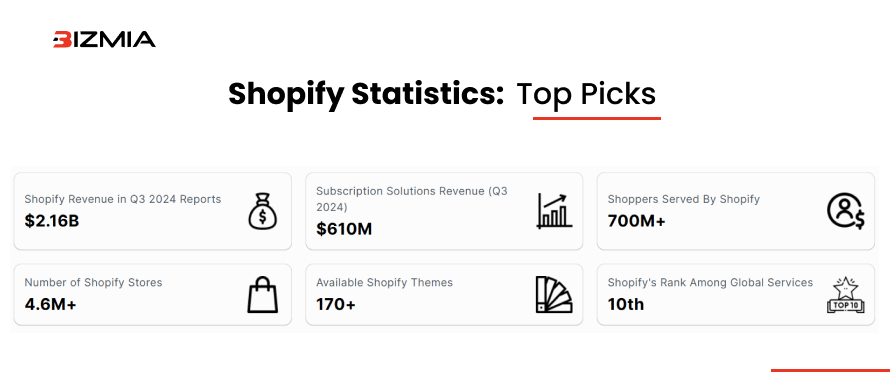
Here are some of the top Shopify Plus recent statistics you should know:
Key Differences: Advanced Shopify vs Shopify Plus
Oftentimes, business owners get confused about whether to choose the Advanced Shopify plan or Shopify Plus.
To solve this confusion, below is the table for advanced Shopify vs Shopify Plus:
Feature | Shopify Advanced | Shopify Plus |
Best For | Growing businesses scaling operations | High-volume enterprises with complex needs |
Monthly Cost | Lower compared to Plus | Significantly higher, custom pricing |
Customization | Limited theme customization | Full code control, custom checkout scripts |
Support | 24/7 standard support | Dedicated account manager & priority support |
API & Integrations | Standard API access | Advanced API with higher rate limits |
Automation Tools | Basic automation | Shopify Flow, Launchpad, and Scripts |
Staff Accounts | Limited Number | Unlimited staff accounts |
Multi-Store Management | Not included | Manage multiple stores from one dashboard |
Transaction Fees | Lower fees than lower-tier plans | Even lower, with negotiated rates |
Exclusive Features | Advanced reports, third-party shipping rates | Wholesale channels, headless commerce options |
What are the Benefits of Migrating to Shopify Plus?
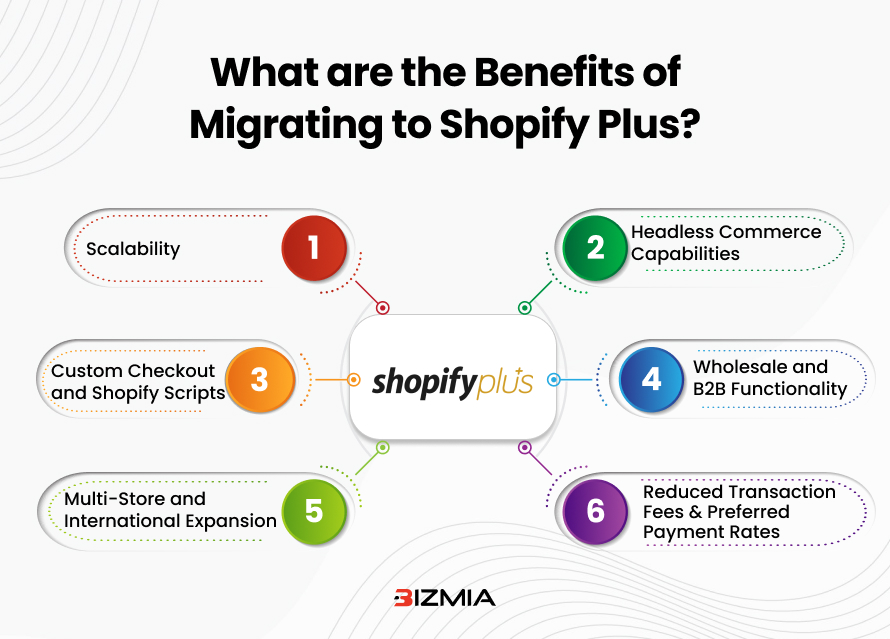
Shopify Plus migration has a number of benefits including scalability, customization, easy management for high-traffic websites, apps and integrations and much more. Let’s take a look below.
1- Scalability
As your business grows and the customer request increases, Shopify Plus provides robust features and tools that you can leverage to provide the best services. Not only that, but you can also enhance your eCommerce store according to the growing requirements. Shopify Plus equips you with unlimited bandwidth for scalable SaaS hosting that equates to having supported, flexible, reliable solutions.
By using it for your eCommerce website, you get to have 99.99% uptime and 4 million hits per second. Also, for holiday seasons and days like Black Friday, Mother’s Day, etc., stay assured that your store will stay seamlessly up with Shopify Plus being capable of 8000 orders per minute. Moreover, customers also get to have 200TB storage capabilities, and unlimited bandwidth for all Shopify customers. The latest Shopify Plus trends, including AI-driven customization, also help boost sales.
2- Custom Checkout and Shopify Scripts
Checkout is one of the most important aspects of running a growing business. Many customers stop at checkout and leave it for some other time (especially when they see a haphazard checkout). Therefore, it is best to create an eCommerce checkout that is customized and developed by keeping in view the customer’s preferences.
With Shopify Plus, you can easily create a customized checkout through Shopify Scripts and Shopify Checkout Extensibility. It translates into merchants having the ability to create advanced discounting strategies, apply tiered pricing models, offer custom shipping rules, or even introduce personalized upsells—all without relying on third-party apps. The ability to optimize checkout can directly improve conversion rates and reduce cart abandonment.
3- Multi-Store and International Expansion
If you want to expand your store internationally, Shopify Plus has all the features you need. With it, you can run multiple storefronts under a single account that make it ideal for international eCommerce operations merchants can easily and seamlessly set up localized versions of their stores with country-specific pricing, currency conversions, region-based tax settings, and multilingual support. In addition to that, you can also utilize features like Shopify Markets to simplify global selling by automating tax compliance, duty calculations, and localized payment methods.
4- Headless Commerce Capabilities
Another reason to choose Shopify Plus is that it provides flexibility and supports headless commerce that allows brands to decouple the front-end from the back end. Merchants have now an option to build a custom storefront (e.g., React, Next.js, Vue.js) while still leveraging Shopify’s powerful commerce engine.
This is particularly beneficial for businesses that want a unique, high-performance user experience across multiple touchpoints, including mobile apps and IoT devices.
5- Wholesale and B2B Functionality
If you deal in wholesale and also want to have B2B functionality, utilizing Shopify Plus would be the best platform. Merchants can develop a B2B/wholesale storefront alongside their direct-to-consumer (DTC) store.
It offers features like tiered pricing, bulk order management, and custom catalogs to allow businesses to serve both retail and wholesale customers efficiently. Additionally, Shopify Plus offers net payment terms and account-based pricing options, making it a powerful choice for brands selling in bulk.
6- Reduced Transaction Fees & Preferred Payment Rates
Other Shopify plans other than Shopify Plus have relatively high transaction fees. However, if you use Shopify Plus, merchants get lower transaction fees and discounted payment processing rates through its own Shopify Payments. So, for example, if you have a high-revenue business that process thousands of transactions monthly then using Shopify Plus would be the best choice as even a small percentage difference can result in significant cost savings.
When You Should Migrate to Shopify Plus
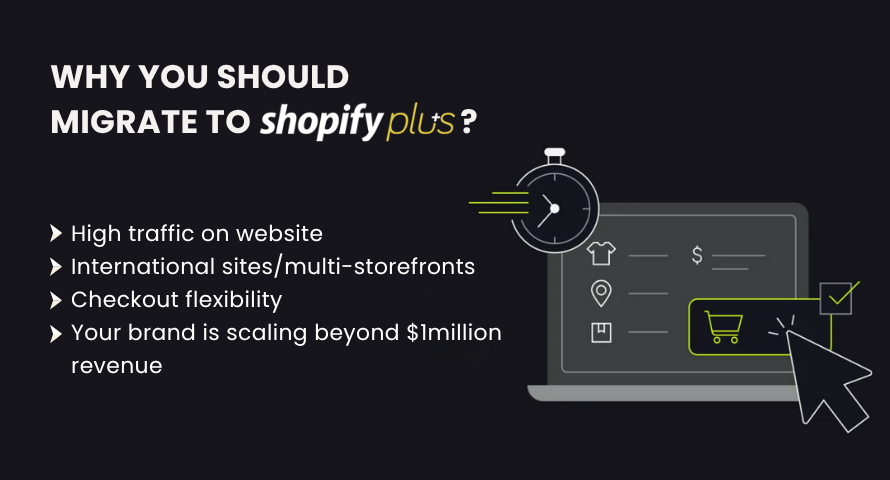
Planning for the timely Shopify Plus upgrade is useful in terms of sales, growth, and reputation. Here are some key indicators when you should plan for a Shopify Plus migration from your existing e-commerce platform:
- When you are observing high traffic flows on websites: During peak traffic seasons like Black Friday or Cyber Monday, your website might face slowdowns, here comes Shopify Plus with 99.99% uptime and enterprise-level reliability.
- When you require international sites or multi-storefronts: Shopify Plus enables localization and multi-store handling (with multiple currencies, tax settings, and languages) for global scale growth.
- Checkout needs flexible options: When merchants want to give custom discounts, wholesale pricing, or loyalty tiers, they can avail Shopify Plus customization services.
- Your brand is scaling beyond $1million in revenue: When your online brand reaches a specific sales threshold, Shopify Plus automation features balance out the higher subscription fee.
How to Upgrade to Shopify Plus in 2025?
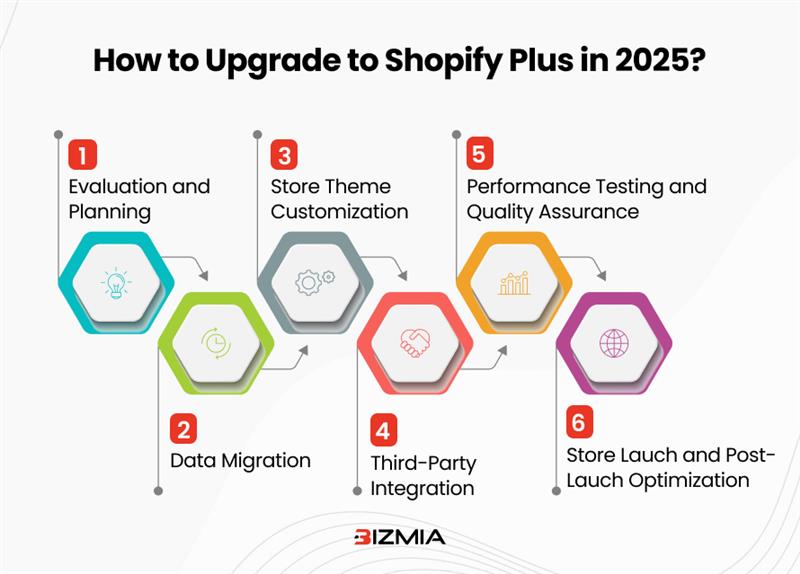
For migrating to Shopify Plus, there are several steps involved. Although it’s not a tricky process but consultation with a Shopify Plus development agency can save you time. Here’s the step-by-step guide on how to upgrade to Shopify Plus from your existing e-commerce platform:
1.Evaluation and Planning
You can start by evaluating your current e-commerce platform or setup, including apps, integration, and themes. Once you are done with the assessment, identify your migration goals, such as scalability, speed, and internationalization.
2.Data Migration
Once you are done with the planning stage, prepare to transfer all your current store data including products, content, orders, and customers. Also, focus on SEO continuity by mapping redirects and URLs in a correct manner.
3.Store Theme Customization
The store theme is brand identity, to maintain this you can either optimize your existing theme or customize a new one which is compatible with Shopify Plus. You can also deploy Shopify Scripts for a smooth checkout experience for shoppers.
4.Third-Party Integration
When your store design is complete, you can proceed to reconnect essential apps, CRM systems, and ERP. To ensure real-time sync with third-party tools, Shopify developers can use Shopify APIs.
5.Performance Testing and Quality Assurance
Before formally launching your Shopify Plus store, run multiple tests to evaluate functionality, mobile responsiveness, and payments. If there’s any issue, fix it, and confirm analytics tracking and site speed optimization.
6.Store Launch and Post-Lauch Optimization
While launching your Shopify Plus store, migrate DNS settings and make it live. Also, ensure post-launch optimization, tracking, and fine-tune automation. Monitor sales/performance analytics time-to-time and fix if required.
Companies can also benefit from hiring Shopify Plus experts who assist in store development, launch, and post-launch support.
How Much Shopify Plus Upgrade Cost?
Now you know how to upgrade your existing e-commerce platform to Shopify Plus, let’s discuss the different finances involved in migration and a comparison of Shopify Plus pricing with other version packages. Migration pricing usually depends on the nature and complexity of your existing store setup:
- If you have already signed up on Shopify and want to move to the Plus version, it may cost you $2000 to $5000 and take 2 to 4 weeks.
- Migration from WooCommerce, BigCommerce, or Magento may cost $8,000 to $25000 and take 4 to 10 weeks.
- Moreover, complex enterprise migration can cost you over $25,000 and 8 to 12 weeks’ period.
Here’s a quick snapshot of different Shopify plans, their cost, features, and what they are best for, analyze each and pick the most suitable for yourself:
Plan | Best for | Monthly Cost | Features | Limitations |
Shopify Starter | Beginners or social media sellers | Around $5/month | Lets you add “Buy Buttons” to existing websites or social profiles, accepts online payments easily | Not a full online store; limited customization and no standalone storefront |
Basic Shopify | Small businesses starting online sales | About $39/month | Includes a full store setup, basic reports, and up to 2 staff accounts | Lacks advanced analytics and automation features |
Shopify (Standard) | Growing stores expanding product lines | Roughly $105/month | Offers professional reports, better shipping discounts, and 5 staff accounts | No advanced automation or checkout customization |
Shopify Advanced | Mid-sized or scaling businesses | Around $399/month | Advanced reporting tools, lower transaction fees, and up to 15 staff accounts | Limited API access and no dedicated account manager |
Shopify Plus | High-volume brands or enterprise-level companies | Starts at $2,000/month (custom pricing) | Unlimited staff, dedicated manager, custom checkout scripts, automation tools like Flow & Launchpad | Higher cost, but tailored for scalability, multi-store management, and performance at scale |
What Are Other Exclusive Shopify Plus Features?
Other than the already-listed features, there are exclusive features to Shopify Plus that make it stand out even more compared to other packages. By using it for your eCommerce website, you get access to exclusive tools such as:
- Launchpad: Automate major sales events, flash deals, and product launches with pre-scheduled changes.
- ShopifyQL Notebooks: Use Shopify’s SQL-like query language to gain deep insights into sales performance, customer behavior, and operational metrics.
- Unlimited Staff Accounts & Permission Controls: Businesses can grant specific roles and permissions to employees, ensuring secure access management.
Some USA-Based Shopify Plus Success Stories
Various American brands have seen incredible success and growth after they shifted to Shopify Plus. Some of the success stories are given here for your inspiration:
Allbirds
They opt for Shopify Plus for rapid global expansion. After this shift, Allbirds observed a considerable 40% improvement in site performance along with high conversions.
Heinz
To launch their D2C channels during the COVID-19, Heinz moved to Shopify Plus, and they are still on it-leveraging automation tools and customized offers.
Kylie Cosmetics
They benefit from Shopify Scripts with personalized checkout experience and scalability via Shopify Plus.
Gymshark
Opted for Magento to Shopify Plus migration to manage peak traffic and flash sales. Now, they are capable of processing thousands of orders in one minute without any lag.
Conclusion
Shopify Plus migration in 2025 is more than a usual shift; it’s a strategic move getting your brand equipped with scalability, automation, and long-term growth. It helps you expand your business seamlessly by leveraging the top features. If you want to grow your business that has multiple payment options, lower transaction fees, minimum lag, high traffic volumes, or targeting international markets, then Shopify Plus would be the right eCommerce platform you should shift to. Moreover, many merchants have started to move towards Shopify Plus in 2025 as the platform is flexible and scalable for their business to grow locally and internationally.