
In 2025, consumers are expecting a personalized shopping experience, secure transactions, and super-fast websites. At the same time, businesses are under pressure to expand globally while maintaining smooth operations. All these challenges can be tackled well by signing up for Shopify Plus. That’s why Shopify Plus development could be the right solution for e-commerce brands. It’s an enterprise-level and premium version of Shopify, built for high-volume retail businesses. With this platform’s enhanced features, better customization options, and scalability can be ensured.
This detailed guide gives all the insights into Shopify Plus development, starting from features and development cost to partnering with a Shopify Plus development agency and future predictions for Shopify Plus that every merchant wants to know.
What is Shopify Plus?
Let’s begin with what is Shopify Plus? It’s a modern version of Shopify suitable especially for enterprise-level businesses. It also caters to the needs of retailers requiring advanced features and high-level customization. Moreover, continuous support, better scalability, and performance are offered by the Shopify Plus eCommerce platform.
Key Features of Shopify Plus
Some significant Shopify Plus features that make it a suitable platform include:
- Unlimited Accounts: An unlimited number of staff accounts is facilitated by Shopify Plus, which is crucial to organizing and maintaining big teams.
- Modern Analytics and Advanced Reporting: Detailed reporting tools provided by Shopify Plus improve the e-store’s performance. Moreover, advanced analytics assist in tracking your store functionality.
- High-level Customization: Advanced customizations offered by Shopify Plus help in running a successful brand by providing underlying access to your store’s code.
- Ongoing Support: Smooth store operationality can be ensured by the continuous and 24/7 support of this eCommerce platform.
- Cross-Platform Selling: With a unified dashboard, you can easily sell your products on multiple platforms such as Facebook, eBay, or Amazon. Moreover, for technical support, a Shopify Plus development agency can be consulted.
How Shopify Plus is Different from Standard Versions
Shopify Plus is the upgraded version of standard Shopify. Let’s see what makes it stand out:
- Checkout Customization: Shopify Plus offers full-scale checkout customization; on the other hand, standard Shopify is limited.
- Scalability and Flexibility: Shopify Plus is capable of handling millions of transactions per minute, while the standard Shopify version is limited to SMBs
- Tools for Automation: Enterprises can automate marketing, sales campaigns, and inventory with Shopify Plus’ exclusive tools like Launchpad and Shopify Flow.
- Dedicated Support: With Shopify Plus, merchants get a dedicated Merchant Success Manager (MSM) and urgent support.
- Shopify Plus Pricing: If we compare Shopify vs Shopify Plus costs, the latter starts at $2000 monthly in the USA, while the Standard version costs a few hundred dollars per month.
Who Shopify Plus is Built for
Shopify Plus is especially designed for
- High-volume e-stores manage thousands of orders daily.
- Direct-to-consumer (DTC) brands require full control over customer experience and branding.
- Large-scale brands expanding into international markets
- Subscription-based brands looking for advanced recurring billing setups
Industries Using Shopify Plus
The following are some of the top industries leveraging Shopify Plus in 2025:
- Fashion and Apparel: Allbirds, Gymshark, Rebecca Minkoff
- Beauty Industry: ColourPop, Kylie Cosmetics
- Food and Beverages: PepsiCo, Heinz
- Luxury Items: Nestle, Tesla merchandise store
- Consumer Electronics: Motorola, Razer
Why Businesses opt for Shopify Plus Development?
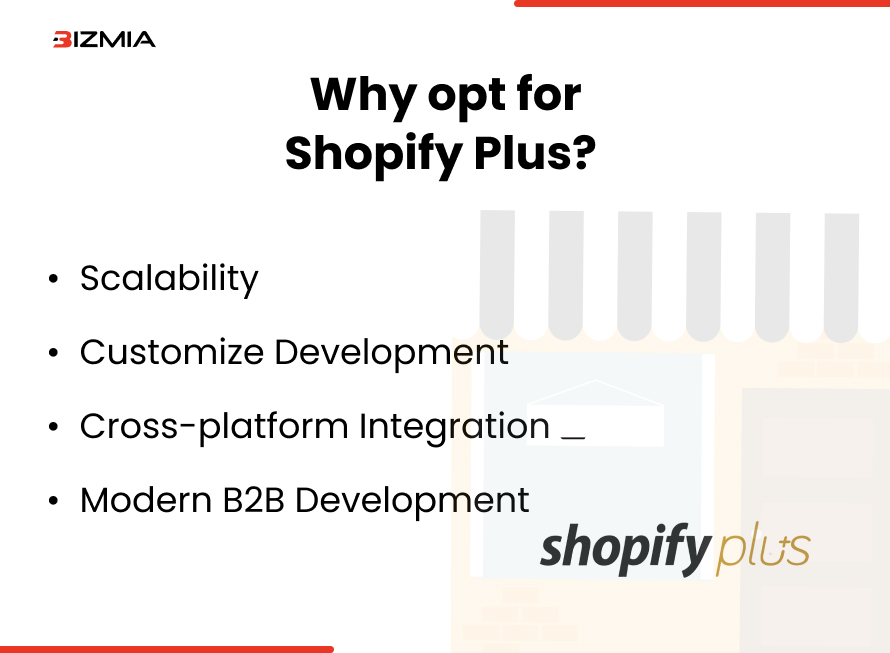
Many businesses looking for growth through a scalable platform opt for Shopify Plus. Here we have collected some top reasons behind selecting Shopify Plus to build your online brand:
- Scalability: If your website observes a large volume of traffic, then Shopify Plus would be an ideal platform to handle such traffic, transactions, and orders placed by customers.
- Customize Development: A store that is perfectly tailored to your unique requirements is not a dream anymore with Shopify Plus. It offers integration and custom coding enabling desired customizations for the store.
- Cross-platform Integration: You can easily integrate your Shopify Plus store with popular sales channels such as social media sites, point-of-sales systems, and marketplaces.
- Modern B2B Development: Shopify Plus B2B business support, in the form of order management tools, custom pricing, and wholesale channels is beneficial for B2B business development.
- Advanced Analytics: On Shopify Plus, brands can have access to custom reports, ShopifyQL Notebooks, and advanced analytics dashboards. Brands can assess customer behavior, ROI, and sales across multiple platforms.
- Security Compliance: Businesses can have PCI DSS Level 1 compliance with Shopify Plus. Also, it ensures early fraud detection and dynamic SSL certificates.
Shopify Plus Store Development: A Complete Process
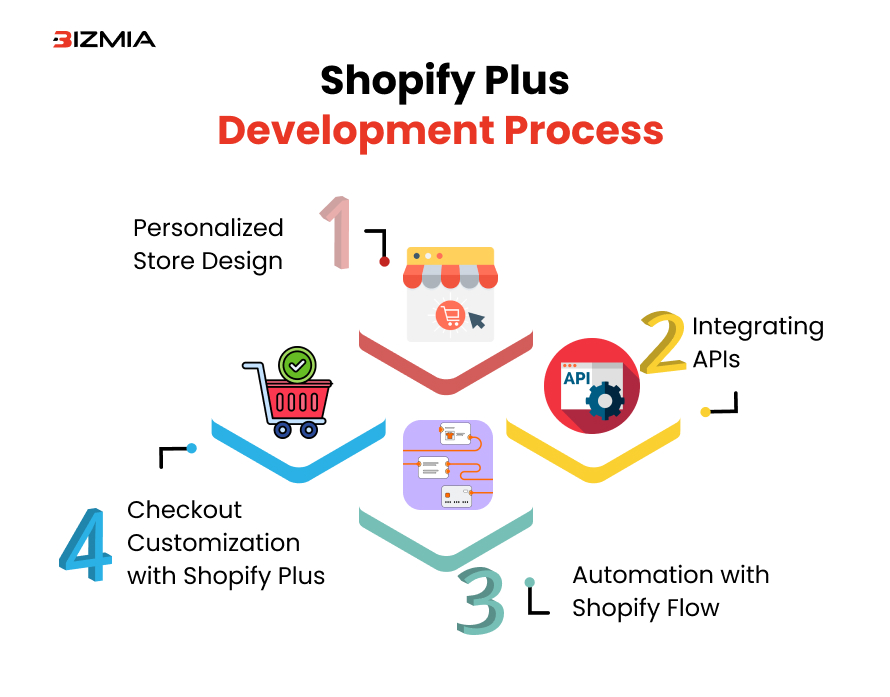
A complete Shopify store development process includes personalized store designing, integration with APIs, process automation with Shopify Flow, and customization of the checkout process. Let’s get into details:
1- Personalized Store Design
The development of a Shopify Plus store begins with creating an online store in line with your brand identity. In comparison with the basic Shopify plans, Shopify Plus offers more scalability in designing your store theme. With the help of a Shopify open-source template language, Liquid, you can seamlessly create your brand theme.
Example:
Let’s have a look at an example of how to customize your cart page:
liquid

{ % if cart. Item_count > 0 %}

< div class = “cart-summary” >

< h2 > Your Cart < /h2 >

< ul>

{% for item in cart. items % }

< li >

< span > {{ item. quantity }} x < / span >

< span > {{ item . product. title }} < / span >

< span >$ {{ item . Line _ price | money }} < /span >

< / li >

{ % endfor % }

< / ul >

< div class = “total-price” >

< span > total : < / span > <span> $ {{cart . total _ price | money }} < / span >

< /div >

< /div >

{ % else % }

< p > Your cart is empty . < /p >

{ % endif % }
Moreover, with the code snippet, it is ensured that your potential customers can have an updated cart view.
2- Integrating APIs
Having API access with Shopify, you can integrate your Shopify Plus websites with third-party systems.
Example:
Let’s figure out how to do product data fetching with Shopify Plus API integration:
javascript

fetch ( ‘https : // your –store . myshopify . com/ admin/ api/ 2023-01 / products . Json’ , {

Method : ‘GET’ ,

Headers : {

‘ X- Shopify – Access –Token’ : ‘your- access- token' ,

‘Content-Type’ : ‘application / json’
}

})

.then( response => response .json ())

.then ( data = > console . log (data ))

.catch (error = > console . error ( ‘Error fetching product data:’ , error ));
So, in this way, you can easily fetch product data with Shopify API. Moreover, integration with other services such as customer relationship management, order fulfillment, or inventory management is possible by utilizing the same API.
3- Automation with Shopify Flow
After designing your store, you can automate its tasks with the Shopify Flow tool. It’s a useful option for retailers to ensure consistency and minimize manual labor.
Example:
You can automatically tag your customer, if an order is placed by the customer (Trigger), for instance, the condition is that the order value must be greater than $500, so in response your client is tagged as ‘VIP Customer’ to their profile.
4- Checkout Customization with Shopify Plus
Smooth checkout customization can be ensured with Shopify Plus. Moreover, integrations with third-party apps, field customization, and checkout page customization are offered. Also, consulting a Shopify Plus development company can help in having a smooth customization process.
Example:
You can customize checkout scripts for discounts with Shopify Plus through this given command:
ruby

#custom checkout discount script for Shopify plus

discount = input . cart . line_ items . sum { |item | item . variant . price *

item . quantity }

if discount > 1000

discount = input . cart . line_items . map { |item|

item . change_line_ price (item . line_price-20, message : “VIP Discount Applied” )}

end Output . cart = Input . Cart
 What Does a Shopify Development Agency Offer?
A skilled Shopify Plus development agency offers all the services that retailers need to scale up their business. Let’s get into the details:
1. Store Setup
When you partner with a Shopify Plus development company, they can start by building your Shopify Plus store. Their services include everything starting from product catalog structuring to sorting payment gateways.
2. Shopify Customization
Shopify expert agencies also offer a custom Shopify Plus development facility. It involves many tasks, ranging from unique product configurations to custom checkout flows. In short, it takes care of every bit of personalization.
3. Shopify Theme Development
Shopify Plus development services also include Shopify Theme development because Shopify Plus design or theme is your brand identity. Retailers can have ADA-compliant and mobile-first designs for their online stores tailored for US shoppers.
4. Shopify App Development
Apps designed as per the business requirements, such as loyalty programs, latest search filters, and subscription-based billing. A reliable Shopify Plus agency can help tailor apps.
5. Shopify Plus Migration
Shopify Development agencies manage smooth migrations like Magento to Shopify Plus migration, and from other platforms like BigCommerce, WooCommerce, or legacy platforms.
6. Shopify Integration
Integration with CRM, ERP, shipping providers, marketing automation platforms, and tax systems can also be streamlined with the help of a trusted Shopify Plus development partner.
7. Shopify Web Development
For better store performance and flexible brand operations, Shopify agencies offer custom web solutions via React, Vue.js, or headless commerce.
8. Support and Maintenance
E-commerce brands can get technical support, performance monitoring, and security updates in the form of Shopify Plus development services anytime.
Common Challenges in Shopify Plus Development
During Shopify Plus website development, you might face certain issues. Let’s read about them so that you can be careful:
- Complexities in data migration, particularly with large catalogs
- Limitations associated with Shopify checkout customization that are beyond Shopify’s built-in tools
- In the USA, it’s a challenge to ensure ADA accessibility compliance for e-commerce websites.
- In legacy enterprise systems, you may come across integration issues.
- For US-based global sellers, international tax compliance is a concern
Best Practices for Shopify Plus Development (2025)
Although there are some challenges, you can tackle them well if you adopt these proven practices, ensuring a smooth Shopify Plus development:
- For speed and design flexibility, implement headless commerce.
- To minimize manual tasks, use Shopify Flow automation.
- With one-click payment and accelerated checkout options, optimize your checkout UX.
- Since 70% of the online traffic in the USA comes from mobile commerce, investing in mobile-first commerce is the best idea.
- Regularly monitoring API integrations and performance
Top Case Studies
Let’s discuss some real-world examples where brands used Shopify Plus for a competitive edge in the e-commerce market:
Heinz (USA)
During the Covid-19 pandemic, Heinz used Shopify Plus to pivot to DTC sales, boosting margins and customer loyalty.
Gymshark
Gymshark leveraged Shopify Plus to handle massive Black Friday orders, avoiding downtime.
Allbirds
With Shopify Plus, Allbirds has scaled globally while maintaining sustainability values and brand identity.
How to Choose the Best Shopify Plus Development Agency
When you are searching for a Shopify Plus development agency, keep the following points in mind:
- They must have a certified Shopify Plus Partner status.
- A Shopify Plus agency should have a portfolio of enterprise-level projects.
- They must have the ability to handle end-to-end services (development, integration, and migration)
- Knowledge of USA e-commerce compliance standards, including sales tax regulations, CCPA, and ADA
- Can offer a strong post-launch maintenance and support facility
How Much Does Shopify Plus Development Cost?
The Shopify Plus pricing usually starts at $2300 per month. However, this amount may vary and depends on multiple factors, such as transactions, the number of orders your brand receives, and additional service charges. Moreover, acquiring Shopify Plus development services can be a good choice for smoothly developing and running your store.
For a basic breakdown of Shopify Plus store development cost, see the given table:
| Development Stage | Cost (In Dollars $) |
|---|---|
| Basic Store | 5000-10000 |
| Customized Theme | 10000-30000 |
| Integrations with Apps | 5000-20000 |
| Integrations with APIs | 10000-50000 |
| Maintenance Charges | 1000-5000/month |
What Future holds for Shopify Plus Development?
New technologies and e-commerce market demands are shaping the future of Shopify Plus in 2025 and beyond:
- AI-powered customization: AI chatbots and smarter product recommendations
- AR Shopping and Voice Commerce: An interactive and user-friendly shopping experience
- Blockchain and Crypto Payments: Secure and faster cross-border payments
- Expansion of Social Commerce: Solid integrations with Instagram Checkout, TikTok Shop, and the latest US-focused social media platforms.