

How To Prepare for Black Friday: E-Commerce 2025 Strategy
Let’s learn how you can prepare your e-commerce for Black Friday 2025, starting from the pre-event to post-sales strategies:
(A) Pre-Black Friday Strategy
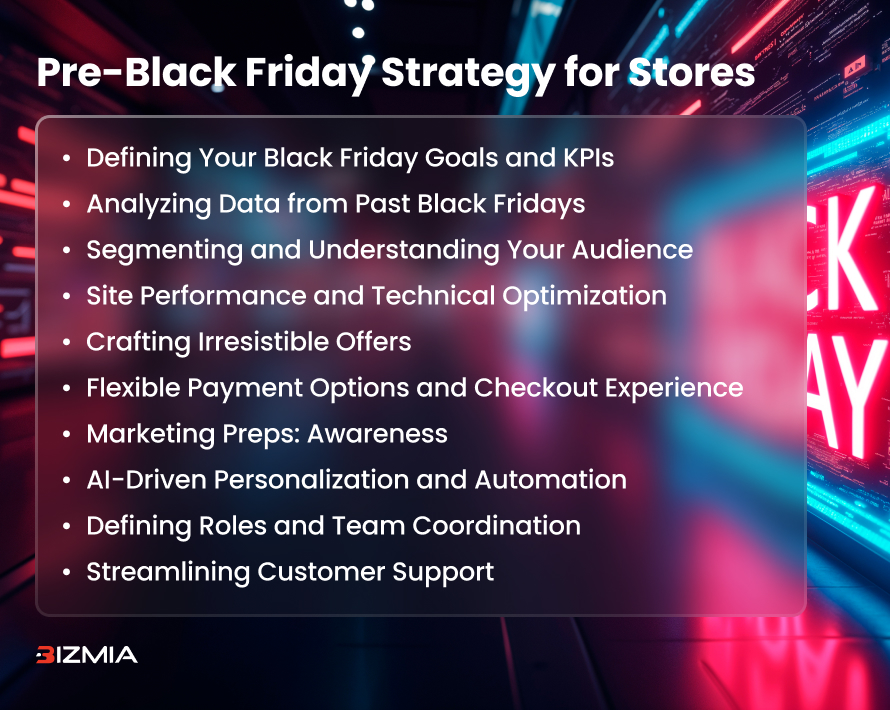
1. Defining Your Black Friday Goals and KPIs
You can always start by defining your goals for the upcoming Black Friday sales and setting up KPIs to evaluate your site according to them. Rather than usual targets, you should set KPIs like a 20% increase in revenue, around 20% boost in subscriber list, 10% conversion rate improvement, and four times marketing ROI. Here are all the objectives listed, what you should evaluate, and aim:
Objective | What to assess | What success looks like |
Revenue Boost | Monitor total revenue and the average value of each order. | Plan for around 20% rise compared to last year’s numbers. |
Getting New Customers | Monitor new sign-ups, first-time buyers, and email subscriber growth. | Aim for a 20% increase in your subscriber list. |
Website Experience+ Speed | Assess site performance through bounce rate + load time. | Pages should ideally open in less than 3 seconds to maintain engagement. |
Advertising Efficiency | Track return on ad spend (ROAS) + campaign profitability | A healthy parameter is a 4 times or higher return for each dollar spent. |
Conversion Rate Improvement | Focus on cart additions + checkout completions | Effort for at least a 10% improvement over last year’s results. |
2. Analyzing Data from Past Black Fridays
As a merchant, you should always analyze your previous years’ Black Friday sales in terms of products sold best, how offers turned browsers into buyers, average order value, when did visitors abandoned cart, and what different sources of traffic on your site. Here are all the metrics given and why they are important for retailers in 2025:
Metric | Why it Matters |
Conversion Rate (CR) | Shows how effectively your promotions turned visitors into actual buyers, a clear measure of campaign success. |
Average Order Value (AOV) | Assists you understand purchasing behavior Guides how to structure bundle deals |
Online Traffic Sources | Shows which marketing channels- whether social ads, search, or email-drove the highest quality traffic and strongest returns. |
Cart Abandonment Rate | Identifies where users drop off in the checkout process, helping uncover UX or pricing-related friction points. |
Email Open + Click Rates | Exhibits how engaging and relevant your email content was throughout the Black Friday campaign. |
3. Segmenting and Understanding Your Audience
Understanding your customers is the secret recipe for successful Black Friday sales. Now they search for personalized deals, not just generic discounts. To address this, you can segregate the audience based on their:
- Browing Behavior
- Interests in Products
- Purchase Power
- Level of engagement
Based on these parameters, you can determine if visitors are frequent buyers or new on the website, what product categories they browse based on their interests, whether they are budget conscious or premium buyers, if they open promotional emails frequently, or if they are social engagers. This would help you in designing a targeted campaign for your brand, such as:
For frequent shoppers—-Loyalty rewards + Easy access
People abandoning carts frequently—-urgency message + retargeting ad
For first-time buyers—-Free shipping + discount coupons
4. Forecasting Inventory and Supply Chain Management
Although Black Friday e-commerce is all about stockouts, if not handled systematically, merchants may bear lost cash flow, product overstock, or delayed deliveries. To avoid this, you can check what the top-selling SKUs, items with the highest margins, highest-selling products, and any dead stock that can be discounted or bundled with other products are. Based on these findings, you can easily forecast product demand for the next holiday season.
Here’s how you can fulfill product demand during the sale season:
Plan | Outcome |
Work with various delivery partners such as FedEx, UPS, and DHL, instead of relying on one. | Minimizes the risk of shipping delays and keeps orders moving even during peak congestion. |
Keep buffer inventory of your most popular items. | Prevents those dreaded ‘Out of Stock’ moments when demand rises unexpectedly. |
Link inventory automatically across sales channels (Shopify, Amazon, eBay, etc.). | Focus on real-time stock accuracy and eliminate the chance of overselling. |
Benefit from smart inventory tools like Katana MRP and Inventory Planner. | Enables your system to predict low-stock SKUs before they run out, improving reorder efficiency. |
5. Store Performance and Technical Optimization
As you know, your store is going to face traffic spikes during the sales season, so your site should be performing fast because a delay of a single second can even cause a reduction in conversions. Here’s how and what to optimize for better performance:
Section to be focused | Optimization | Parameter |
Homepage of website | Minimize:
| The page should be loaded in under 3 seconds on all key devices. |
Product Pages | Apply schema markups to ensure availability, pricing, and product reviews for better visibility in search results. | Expect a considerable boost in organic click-through rates. |
Checkout Flow | Incorporate autofill capabilities + consolidate steps into a single-page checkout | Plan for a 15% or more rise in completed orders. |
Mobile User Experience | Make sure buttons are comfortably tappable and include “Add to Cart” calls-to-action to maintain engagement. | Target 60% or more conversion share from mobile traffic. |
Hosting Setup | Increase server/cloud resources ahead of seasonal surges to accommodate up to 5x the usual visitor volume. | Maintain 99.9% or better uptime during campaign peaks. |
Caching + CDN | Implement a content delivery network like Cloudflare, Akamai, or AWS CloudFront to serve assets from the closest data center. | Deliver pages and media faster for users globally. |
6. Giving Appealing Offers
E-commerce success this Black Friday is not totally dependent on discounts. Every brand is offering deals, and shoppers are looking for them, so your offers must be irresistible and properly structured. You can offer tiered discounts based on amount spent, buy more, save more offers, bundles, and loyalty perks. Offering customized offers is one of the key features of a successful e-commerce store, especially in 2025.
7. Payment Flexibility and Checkout Experience
Mostly, buyers leave the cart during checkout; you can adopt this Black Friday strategy of making your checkout section effortless. You can remove mandatory account creation options, also add multiple payment options like Apple Pay, PayPal, BNPL, or Google Pay. Another good Black Friday e-commerce tip is to give an incentive of free shipping or 5% off.
8. Marketing Preps: Awareness
Your brand marketing is the key to a successful holiday season. That’s why you should start working on marketing 4-6 weeks before the main event. For a successful marketing strategy, segment your shoppers based on their interests and shopping patterns. Then you can target different social media and electronic platforms to run campaigns.
9. AI-Driven Personalization and Automation
People are searching for personalized deals in 2025 through AI search. Your e-commerce store should be all set for it by aligning AI search and holiday SEO strategies. You can offer AI-driven product recommendations, pricing, and chatbots.
10. Defining Roles and Team Coordination
To avoid any issues during Black Friday 2025 sales, you should confer responsibilities on the relevant team members, including marketing, technical, logistics, management, and the customer support team. Have a look at the given table:
Team | Duties |
Marketing Team | Manages: |
Technical Team | Keeps the site running by: |
Customer Support Center | Handles live chat |
Fulfillment + Logistics | Oversees order processing |
Management | Take care of overall coordination |
(B) Post Black Friday Strategy for Customer Retention
When you are preparing for Black Friday sales, always plan for post-event scenarios as well. It may include regular follow-ups, rewarding loyal buyers, improving the customer base, and getting ready for the next year.

1. Regular Follow-ups
Once the 2025 shopping season is over, you can send customized ‘thank you’ mails or messages to shoppers, give premium Cyber Monday deals to Black Friday shoppers. You can also ask buyers for reviews as follow-ups.
2. Reward Customer Loyalty
Another post-Black Friday strategy is to convert Black Friday buyers into lifetime shoppers. For this purpose, you can start a loyalty program, provide birthday or anniversary discounts. For future sales, you can send them early access invites.
3. Improving Customer Base
You can boost your customer base via content marketing, including style guides, UGC features, or product tutorials. Merchants can also send offers through email segmentation. Also, win-back campaigns can be launched for dormant buyers.
4. Learning + Improvement for Black Friday 2026
Merchants should learn from their mistakes and wins and observe what messages got the most clicks, discount offers utilized the best, and what products caused delays or stockouts during Black Friday 2025. This will help store owners keep their sites Black Friday 2026-ready.
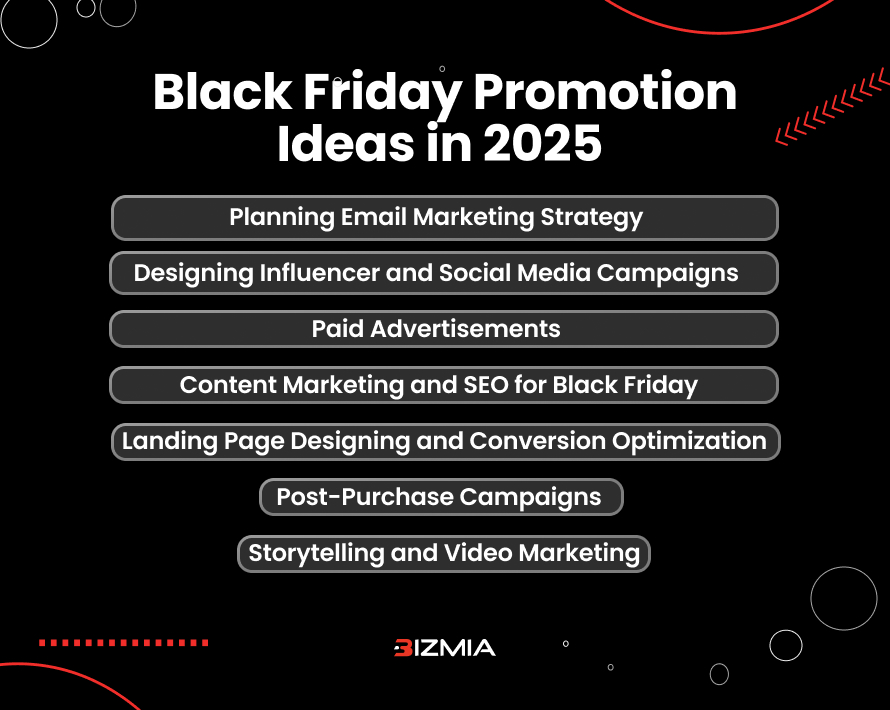
Black Friday Promotion Ideas in 2025
Retailers can adopt these Black Friday promotion ideas for their brands:
- Planning e-commerce holiday marketing email Strategy
- Designing Influencer and Social Media Campaigns
- Paid Advertisements on multiple platforms
- Content Marketing and SEO for Black Friday
- Landing Page Designing and Conversion Optimization
- Post-Purchase Campaigns to turn shoppers into lifetime buyers.
- Storytelling and Video Marketing with the help of influencers (best to attract the Gen Z audience)
 Wrapping Up: Not Just Sale-Ready, Be Black Friday Ready in 2025
Buyers in 2025 are more informed, empowered, woke, and impatient. They are searching for personalized recommendations, fast websites, and smooth checkout experiences for users. A usual discount offer can’t cater to them; but a data and AI-driven e-commerce, trustworthy, and memorable shopping experience will. If these things are ensured, then it is not just Black Friday, but the whole sale season will become a golden brand-building opportunity.